
PLEASURE SCHOOL · PUBLIC REVIEW
Tickling
Fingertips, anticipation and the tickle you actually want
Review draft · Version 4
A tickle can be foreplay, or it can be the sex you wanted all along. Learn to make a light line with a fingertip, tease with a soft cloth, change the timing, and find out what turns each of you on while leaving the receiver free to move.
12 lessons, illustrated teaching, solo practices, and 36 optional quiz questions.
Choose a lesson
- Ask for a tickle as sex
- Let laughter have an exit
- Draw a line, flutter, lift
- Choose the place where the hand turns back
- An arch without a grip
- Make the wait part of the tickle
- A quick touch, a slow return
- A soft edge, a fold or a brush
- Give the game a director
- Tickle between kisses, or alongside another touch
- When the lovely bit is over
- Two evenings, two very different tickles
01 · Ask for a tickle as sex
Lesson notes
Invite wanted tickling, try one clear touch and discover what each person finds attractive about it.
“I’d like you to tickle me tonight.” Kit looks up from undressing. “As in trying to make you laugh?” “As in I’ve been thinking about your hand at my waist since breakfast.” Now they’re having the conversation Rowan wanted.
Start with the bit you’ve been thinking about
Rowan wants the side of their waist touched lightly through a T-shirt. They like the tickle itself and the feeling of somebody taking their time to give it. Kit likes watching Rowan choose the moment. They lie close on their sides with room to move apart. “One along here?” Rowan shows Kit the place and says yes. Kit draws the pad of one finger lightly along that side over the cotton, then lifts the hand away.
Rowan laughs once. Kit gives them room to answer. “A bit ticklish?” “Very. I liked it. Do it once more, same way.” That last sentence tells Kit something the laugh couldn’t. A laugh can come out before somebody can say the touch feels awful. If they pull away, go quiet in a way you can’t read, or ask to stop, take your hand away immediately. Keep it away until there’s a clear, freely given invitation.
Find out who wants what
For one lover, the light passing touch builds sexual excitement. For another, the arousing part is being the one whose fingertips their partner is watching. Some people want tickling as the whole sexual encounter. Some like a little of it before something else. In a survey recruited mainly through communities interested in tickling, respondents described enjoying anticipation as well as the sensation itself. People outside or inside those communities can also find tickling merely funny, irritating or entirely unappealing.
Try telling a lover which bit is yours. “I want the tickle itself. I don’t want to go any further tonight.” Or “I fancy giving it. You can save my feet from your attentions, though.” Rowan wants another pass and nothing more ambitious. Kit is delighted to have spent breakfast in somebody’s thoughts without even being in the room.
A QUICK NOTE TO YOURSELF
Put the sexual part into words
Optional. Keep your notes private.
- Write the invitation you’d actually give. Include what draws you to giving or receiving, where one touch would go, and what you hope might happen after it. Leave your partner room to want something different.
Offer a place and make one pass
Optional · At your own pace
- Choose a comfortable patch on the side of your clothed thigh or on your sleeve. Point to the place where a short line would begin and end. Using the soft pad of one finger, draw that line lightly once and lift the hand fully away.
- Try saying whether you would want the same touch again, a change, or to finish there. Your own touch may feel quite different from a partner’s. You can still practise offering a place and an answer.
You can point at a drawing, guide a finger through the air or simply describe your imagined answer. Physical touch and arousal are optional.
With a partner
The receiver can point to a patch on their sleeve. The giver asks, “One little line here?” If both want it, try the line once, lift the hand, and let the receiver say how it felt.
Take with you: A tickle can be the sex you came for. Let a partner tell you what they enjoyed and whether they want it again.
02 · Let laughter have an exit
Lesson notes
Keep an immediate way out available even when tickling makes speech difficult.
Nico practises their chosen stop signal while seated beside Maya. A dramatic open palm. Very clear indeed. Then they try the position they actually want and discover that Maya would be looking at the back of Nico’s head.
Choose a signal your lover can notice
Nico wants light tickling across the upper back, with Maya sitting at their side. Words are fine until a laugh gets in first. Their other idea is a tap on Maya’s forearm, which Nico can reach without turning over. They try it before any tickling. Maya lifts their hand clear on the first tap. Nico can also say stop, draw away or raise their hand. Nobody has to remember a password to get a lover off their skin.
Choose a signal that works with your own movement and communication. It might be a gesture in view, a touch the giver can feel or a familiar device within reach. Prove it works from the position you’ll actually use. If the person giving can’t tell what their partner wants, the hand comes away. A pause where both people can answer is a fine thing to build into a tickle, even if they never need their chosen signal.
Leave room for a body to change its mind
Maya keeps their weight on the seat and their free hand on their own thigh. Nico can sit up or move away without taking Maya along. When the fingertip gets a laugh and Nico shifts away, Maya lifts right then. “You didn’t have to say the word. I saw you move.” Nico grins. “Good. I’m done with that spot.” Be prepared for a reflexive movement before you go anywhere sensitive. Get clear of a hard edge, a glass or a place either of you could fall.
Keep wrists, legs and the chest free. Leave the face and throat alone, and never pin, immobilize, obstruct breathing or use a hand to quiet the laugh. If laughter makes speech difficult, stop touching and let the person answer freely. A prearranged signal adds a way to stop. Its absence doesn’t turn a flinch, silence or distress into consent.
A QUICK NOTE TO YOURSELF
Spot the missing exit
Optional. Keep your notes private.
- A receiver has a great view of the wall and a stop gesture their partner can only see from the front. Write the one change you’d try first and what you’d do if communication became unclear anyway.
Try a cue from the real position
Optional · At your own pace
- Sit or lie in an arrangement you might actually enjoy. Mark where a partner would be with a pillow, a chair or your gaze. Make one signal and consider whether the person there could see, hear or feel it without you moving unexpectedly.
- Try resting back or turning a little. If the signal disappears, choose another. Play the giver next and practise taking the whole hand clear as soon as the cue starts.
Use your own communication aid, a sound or an imagined touch in place of a hand gesture. If no cue is reliably available, choose an arrangement that allows ordinary conversation or leave tickling out.
With a partner
Settle clothed beside a willing adult and try the cue without tickling. Let either person move away once without giving it and have the other demonstrate the same immediate hands-off response.
Take with you: A signal is an extra exit. Lift immediately for words, withdrawal, distress or uncertainty, with room for the receiver to move.
Sources & further reading
03 · Draw a line, flutter, lift
Lesson notes
Give two different light fingertip tickles and use the receiver’s description to choose between them.
Somebody says, “Use your fingertips,” and you discover that fingertips have several quite different opinions about what that means. The part of your finger that unlocks a phone is a good place to start.
Let the soft pad lead
Start with washed, dried hands, smooth nail edges and a comfortable piece of intact skin the receiver has offered. With your fingers relaxed, bring the fleshy pad of the index finger almost flat onto the surface. Draw a short light line, following the curve of the skin, then lift the entire finger clear. The drawing shows the move on a forearm. A lover might ask for that same line along the outside of a hip or across a shoulder.
Rhea offers the bare skin on the back of one upper arm. One slow line there raises a smile. She likes the first hint of the fingertip more than the long trail afterward. “Can you give me those little starts again?” Dev starts at the same place, makes a shorter sweep and lifts. Rhea has just edited the touch down to her favorite bit.
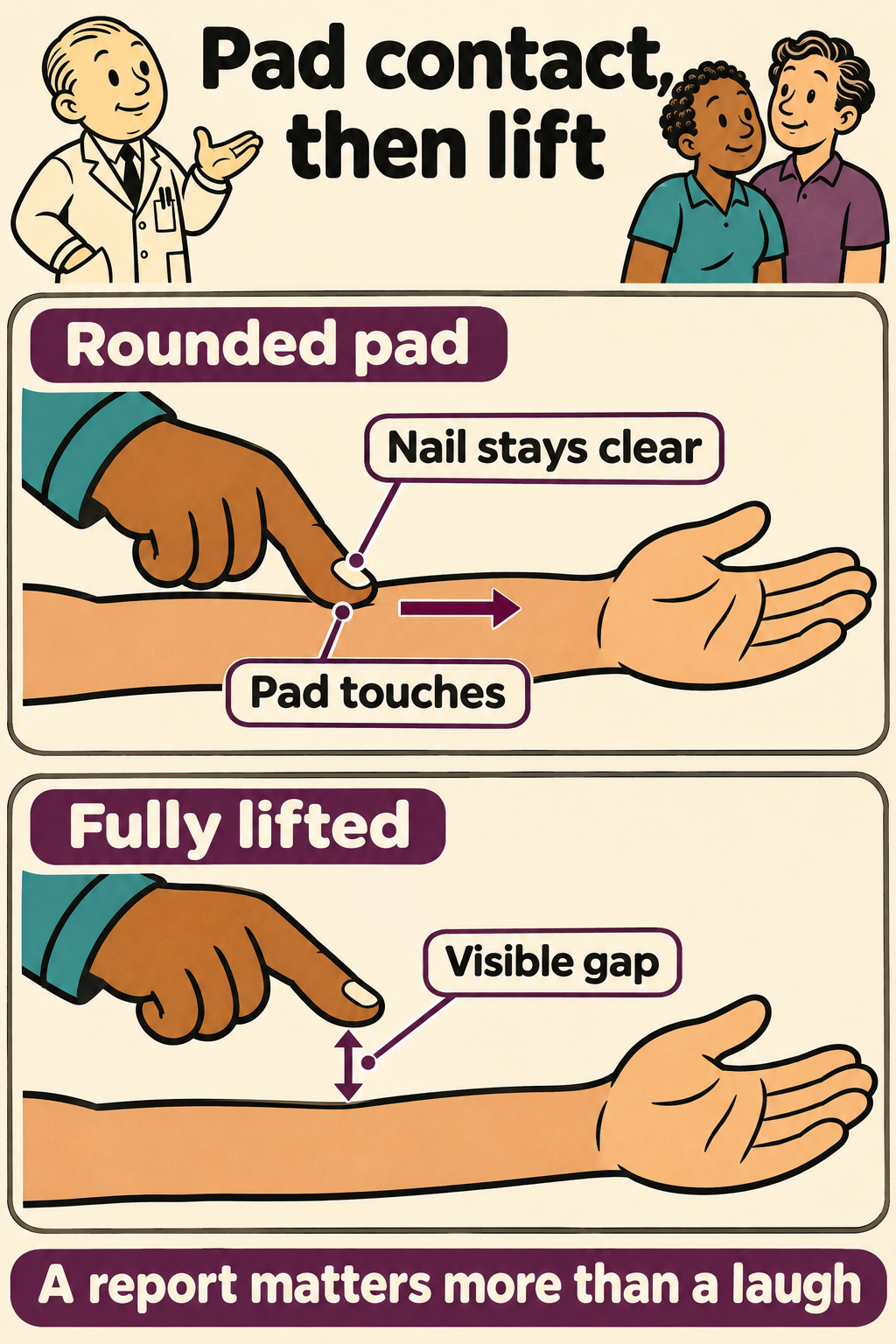
Make two pads feel different from one
For a flutter, lower one finger pad lightly and lift it as the next pad arrives nearby, then lift that one too. Keep the rest of the hand relaxed. Rhea asks to try it. Dev alternates two pads once, entirely inside the area she offered. She laughs this time and says she preferred the short sweep. Dev goes back to it. A person who likes the quiet version owes nobody an encore of the noisy one.
If a touch feels sharp, scratchy or as though the skin is being poked, lift. Check whether a nail led the movement or the fingertip was pointing straight down. A broader, flatter pad may feel better, if the person wants to try it. Sore or irritated skin gets left alone. Someone who would rather have a steady palm can ask for that distinct touch and leave tickling for another time.
A QUICK NOTE TO YOURSELF
Translate ‘just the beginning’
Optional. Keep your notes private.
- A partner likes the instant a fingertip arrives but dislikes being stroked along a long line. Write one short movement you would offer and the words you’d use to find out how it felt.
Feel the difference under your hand
Optional · At your own pace
- On your own comfortable forearm or a sleeve, try a light line with the fleshy index pad and lift completely. Notice whether the nail stays clear. Shorten the line while keeping its touch light.
- Try the other hand pattern. Alternate index and middle pads gently over a small patch, lifting one as the other touches, then lift them both. Which movement could you give cleanly without having to concentrate on your nails?
Trace both motions on a folded towel or in the air, or describe them to an imagined giver. One finger can rehearse the difference between a long sweep and two separate touches.
With a partner
A willing adult can offer a patch of forearm. Invite them to choose a line or flutter, then ask which part of the movement they would keep. They may prefer neither.
Take with you: A light line, a short sweep and an alternating flutter give a lover different things to choose from. The lift belongs to every version.
Sources & further reading
04 · Choose the place where the hand turns back
Lesson notes
Give an invited tickle at an erotic boundary without wandering onto a different body area or under clothing.
“Right up to the edge,” Ben says. “This edge?” Amal touches the seam on their own jeans. Ben points to the side of his thigh. “Further down. My idea of daring is apparently several inches south of yours.”
Let the receiver show you the path
Ben would like fingertips along the outside of his thigh over thin shorts. He draws the route over the fabric, starting just above the leg opening and following the outside seam up his thigh. He taps the stopping point just below his hip. The possibility of a lover giving that patch such deliberate attention is what turns him on. He doesn’t want a hand underneath the shorts or on the inner thigh. Amal can now enjoy going right up to the place Ben picked without wondering where it is.
Ben rests on his back and Amal sits beside his thigh, leaving him room to bend his knee or roll away. On Ben’s invitation, Amal runs one light pad along the agreed strip of fabric and lifts at the end. Ben can feel the fabric move with the fingertip. “I liked the last bit nearest my hip. Can you do just that part?” Amal starts a little closer to the hip, on the same outer strip, makes a shorter pass and lifts where they did before.
A good patch may be quite small
If a partner wants to move the tickle, ask them to show the new spot or name its edges in their own words. “A little higher” could mean along the side of the waist, toward a breast, or simply closer to a shirt seam. Permission to tickle a thigh or waist leaves breasts, genitals, anus and other uninvited areas out of it. Bare skin and clothing can also feel quite different. A rumpled shirt exposing skin halfway along your path is a good reason to lift and offer to straighten it.
A person can adore their lover’s hand at their waistband and find rib tickling unbearable. Another may welcome a shoulder blade and find a waistband about as erotic as doing laundry. Let the receiver’s words choose a new place. A spot they offer a second time may turn out to be the entire point of the evening.
A QUICK NOTE TO YOURSELF
Name a start, a turn and a boundary
Optional. Keep your notes private.
- Describe a short path on a clothed or bare area you might welcome, or invent one for a fictional adult. Include a place close by that the invitation leaves out.
Trace to a boundary and lift
Optional · At your own pace
- Use a seam, a cuff or a fold on a sleeve, clothed thigh or piece of fabric. Pick a starting point and choose a stopping point a little short of an edge. Trace to it and lift before crossing.
- Bunch or move the fabric. Work out whether you can still reach the original patch. If the change exposes skin or hides the boundary, rehearse lifting away and asking for the place to be shown again.
Use two marks on paper, or describe an imagined route from a fixed landmark to another. You can rehearse recognizing a boundary without touching a body.
With a partner
Invite a willing person to choose two points on a sleeve. Trace only the route they chose once, then have them point to a smaller portion they’d like to keep or say they’re finished.
Take with you: A lover can want the pleasure of touch near an edge and want that edge kept exactly where it is.
Sources & further reading
05 · An arch without a grip
Lesson notes
Offer a wanted foot tickle, alternate pads on an agreed part of the arch and leave the receiver free to withdraw.
Jo likes feet. Val likes having theirs admired. Between them there is a genuinely important third question. “Do you want me to tickle yours?” Val considers. “The arch, yes. My toes deserve their privacy.”
Put the foot somewhere it can leave
Val reclines with the lower leg resting on the bed, the heel comfortably supported and the sole within reach. Jo sits to the side, clear of the path a foot might take if it jerks away. The leg can bend and the foot can return to Val at any moment. Jo’s other hand stays on their own leg. Holding an ankle still would turn an easy little withdrawal into having to pull away from a lover.
Val has chosen a patch in the curve of the arch. On the invitation, Jo touches there with the soft index pad and lifts as the middle pad touches nearby, then takes both fingers off. The motion is light enough to give each pad its own arrival. No nail edge, scrubbing or pressing into the sole. The steady attention to that one patch is part of what Jo likes about giving a foot tickle. Val likes feeling the two different arrivals and knowing Jo will leave the toes alone.
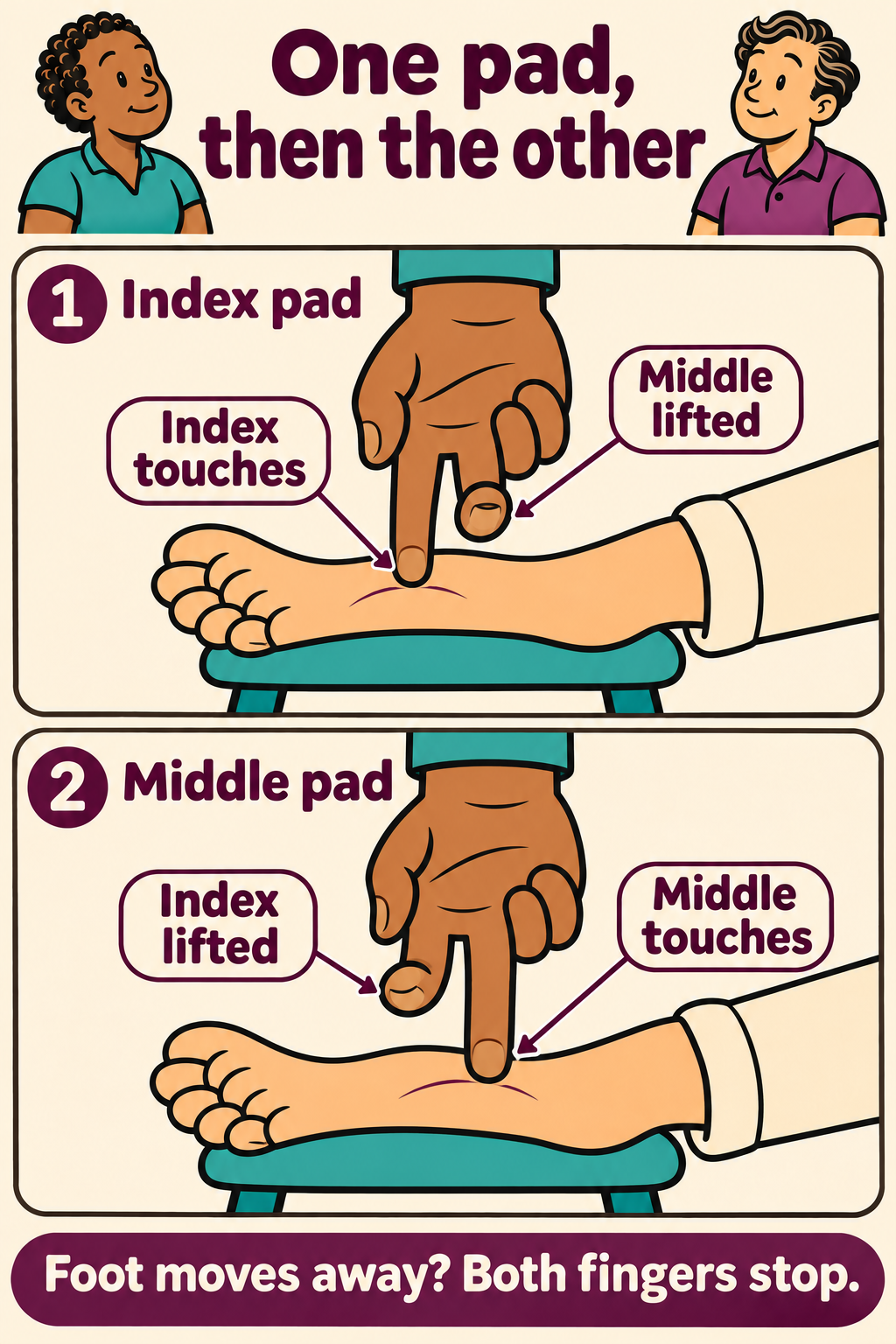
Let a retreat have its say
Val asks for the same little alternation again, then instinctively bends the knee and brings the foot back. Jo lifts both fingers and rests the hand in their lap. “Too much?” “No, I liked it. I also quite like choosing when you get it back.” Val waits a moment, then settles the heel on the bed again. “Same place.”
If a first contact sends the leg flying or feels awful, finish the foot tickling. A different angle, a sock or firmer contact is only worth discussing if the person wants a different kind of sensation. A lover who likes the look of a foot, being touched through socks or having a foot held outside a tickling scene may still dislike every tickle on the sole. Those are separate invitations.
A QUICK NOTE TO YOURSELF
Ask the question admiration leaves open
Optional. Keep your notes private.
- Write what you might ask a partner who likes you looking at their feet. Give them a way to choose one area they’d welcome, a different kind of touch, or no foot contact.
Work the two pads beside a free foot
Optional · At your own pace
- If it’s comfortable to reach your foot without bending or straining, rest the lower leg against something stable. Try one light alternating contact on the arch and bring both fingers clear.
- Settle one foot where it can move away from the imagined giver. Bend the knee or slide the heel back a little, keeping both hands out of its path. Notice where a partner could sit without blocking that retreat.
A rolled sock can stand for the sole while you practise the two pads. If leg movement is limited, choose a signal the giver can notice and an arrangement where the giver can lift fully and move back immediately.
With a partner
With a willing adult, first check that the receiver can withdraw the foot easily while the giver’s hands are still away. Only if they choose it, try the single light arch pattern and let them decide whether to offer the foot again.
Take with you: Admiration, holding a foot and tickling its arch are different invitations. For a tickle, the foot stays free and the hand releases.
06 · Make the wait part of the tickle
Lesson notes
Choose what can be a surprise and how the receiver can start or end the wait.
“I want to know where,” Helen says. “I’d quite like to wonder when.” Jules has just learned why asking a lover if they like surprises can produce such an unsatisfactory answer.
Give the waiting a shape
Helen and Jules like a light tickle at the side of Helen’s bare waist. They’re in bed facing each other, with room for Helen to roll back. Tonight Helen wants to see Jules’s hand approach. “Show me first. After I nod, you can pick your moment.” Jules holds up the hand and Helen nods. When Jules brings a fingertip down, it traces one light line along her side, then lifts clear. Helen is quiet. “That little bit when I knew you were about to touch me? That was lovely.”
Jules likes the view from the other side. Helen has been watching those fingers with the concentration usually reserved for someone about to kiss her. A little uncertainty over when can be exciting precisely because the where is settled. If a partner likes hearing what will happen, try a plain promise you can keep. “When you say now, I’ll go along this side once.” A person who wants the exact moment can be just as keen on being tickled.
Let them change their mind about the suspense
On the next go Helen says, “Actually, all that hovering is making me tense. Tell me just before this one.” Jules brings the hand back to their own lap. “Still want the same tickle?” “Yes. Tell me, then do it.” “Now.” Jules draws the line. This time Helen can enjoy the tickle without bracing for it. She wants to kiss Jules afterward, and that’s enough tickling for tonight.
The hovering hand is part of the tease, too. If someone pulls back, goes still in a way you can’t read, gives their signal or asks to finish, take the hand away and end the suspense. Quietly waiting over their skin for them to stop laughing keeps them under the same pressure. Let them decide whether they want another approach. Being a good tease includes knowing when to sit back and look innocent.
A QUICK NOTE TO YOURSELF
Name the part of a surprise you want
Optional. Keep your notes private.
- Finish two sentences in the receiver’s voice. “Tell me this much before you touch me …” and “This part can be your choice …” A preference for knowing exactly when is a complete answer.
Practise the approach, the start and the retreat
Optional · At your own pace
- Hold one hand over a clothed thigh, the other arm or a tabletop. Rehearse the giver’s part twice. First say when you’ll start, make one light pass and lift. Then raise your hand, wait for an imagined invitation, and choose a moment for the same pass.
- On a third approach, call ‘enough’ before there is any touch. Put the hand back in your lap. Notice the difference between hovering in readiness and actually ending the tease.
Trace the approach and retreat in the air, use a communication aid for the cues, or speak both parts without moving. The solo exercise rehearses the timing you offer.
With a partner
With a willing adult, invite them to choose an announced start or a little uncertainty at an agreed spot on a sleeve. Let them end the approach before contact if they choose.
Take with you: A lover can want the tickle, the waiting, or both. Give them a way to change either one.
Sources & further reading
07 · A quick touch, a slow return
Lesson notes
Distinguish a slower pass, a shorter pass and more time without touch so you can keep the part that turned a lover on.
Fin’s quick sweeps across Mar’s upper back have fallen into time with the music. Between touches, Mar reaches over to turn it down. “I love that song. I just don’t want a tickle on every beat.”
Listen to what happens between touches
A pass has a speed and a length. Once the hand lifts, there’s also the time before it comes back. Fin had been drawing light, quick lines and returning almost immediately. Mar likes the little shiver each line gives them but wants it to fade before the next begins. Fin keeps the next line quick and lifts away to their own side. Mar is the one who says, “Again.” That stretch with no hand on the skin is part of the new rhythm.
If Mar wanted a slower pass along the same route, Fin could take more time going from the same beginning to the same end. If Mar wanted a shorter tickle, Fin could lift earlier along the line. A very slow stroke can actually leave somebody being tickled for longer than they wanted. Let a lover give you the more useful word, particularly when they’re asking for less.

Know when to repeat the one you’ve got
Mar is quieter with the longer pauses. Fin had rather enjoyed hearing them laugh. “When your hand comes off, I can still feel the line,” Mar says. “I love that. Keep that rhythm going for a while? I’ll tap when I’ve had enough.” Fin repeats the quick sweeps with those long rests. Now Fin looks forward to the rests, too. At Mar’s tap the tickling ends.
Try one change first when something nearly works. It will be easier to hear whether the requested change helped. If the person says the tickling is too much, stop before trying to sort out which piece was too much. They may have precisely the words you need once your hand is off them. They might also have the single word ‘done.’
A QUICK NOTE TO YOURSELF
Translate one ordinary request
Optional. Keep your notes private.
- Give two different meanings that “slow down” could have during tickling. Write a short reply that finds out which one your partner means without continuing to touch them.
Make three rhythms with one finger
Optional · At your own pace
- Pick two points on your sleeve or on a table. Make a quick, light pass between them, lift fully, then repeat it. Make the same two passes again, this time with a longer hands-off pause between them. Keep your fingertip moving at its original speed.
- Use the same endpoints again, this time moving more slowly. For the last comparison, go back to your original speed but lift halfway along the route. Which change would you ask for if you loved the tickle and wanted more time to feel it fade?
Tap or hum the moments of first contact and release, or verbally direct an imagined hand. There is no target duration or number of passes.
With a partner
Have a willing adult request one of the three changes while the giver demonstrates on a sleeve or in the air. Let the receiver ask to preserve one part and change another.
Take with you: A slower fingertip, a shorter line and a longer pause feel different. Find out which change the receiver actually wants.
Sources & further reading
08 · A soft edge, a fold or a brush
Lesson notes
Choose how much of a soft material touches the skin and keep seams, hard brush parts and irritating fibers out of the tickle.
The softest thing in Bea’s drawer has a label stiff enough to scratch an itch through a sweater. Bea folds the label well inside. The rest of that little cotton square has much better manners.
Find the part of the cloth you want to feel
Oli likes the idea of being tickled across one bare shoulder blade while Bea sits beside them. Bea shows them the clean, soft, well-washed cotton. Oli picks a smooth corner, clear of the seam. Bea holds it loosely and lets the cotton skim the spot Oli chose. Off it comes at the end of one sweep. The light, narrow edge feels fiendishly ticklish to Oli. Nice for that first taste, too much for the next one.
“Could I have the soft part all at once?” Bea folds the cloth loosely so a wider face can glide over the same place. Oli prefers the fold. There’s still a tickle, with more of a caress in it. A different person might adore the loose corner and barely register the fold. “Would you like the fold again, or my fingertip this time?” lets the receiver choose before anything new lands.
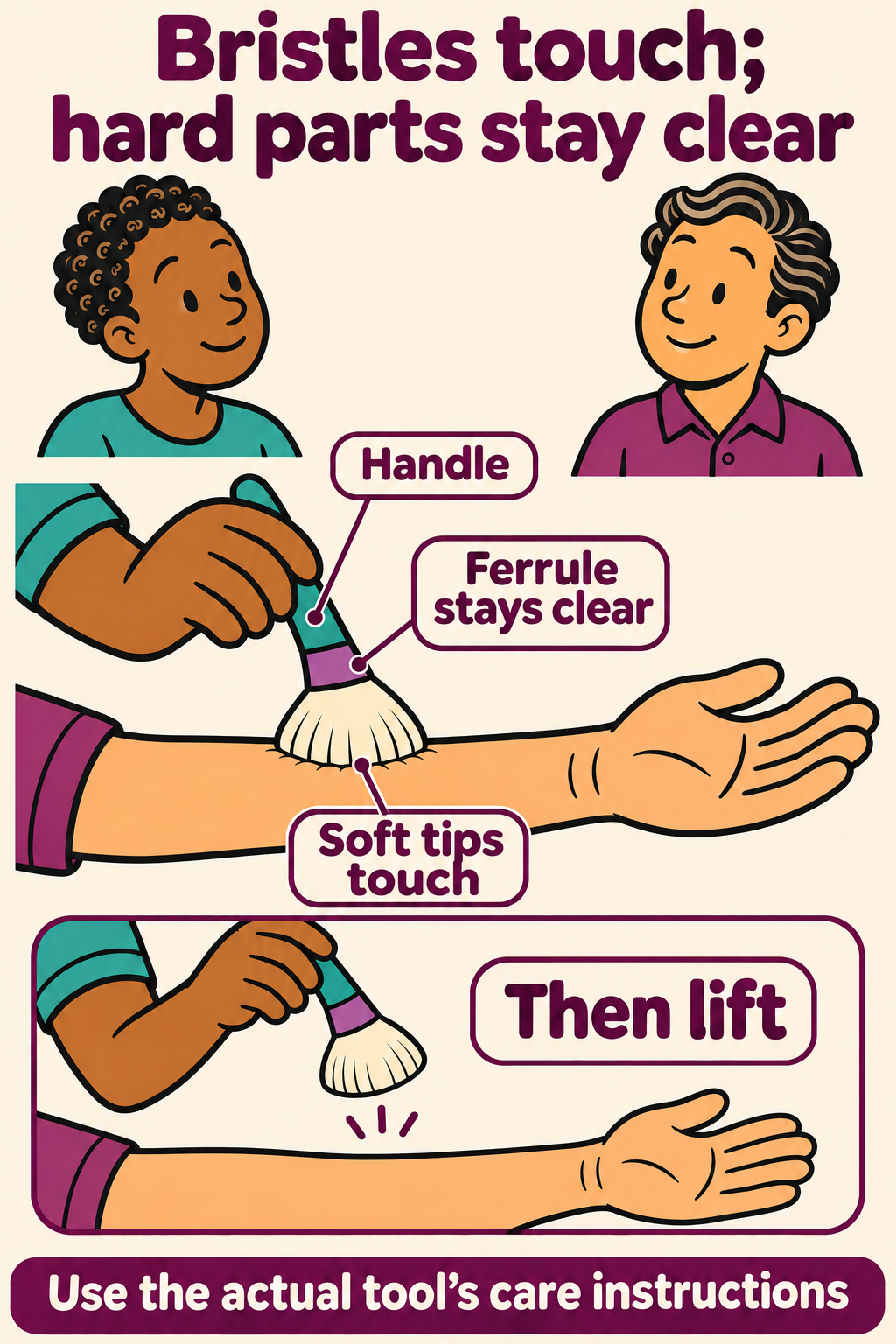
Let bristle tips do the touching
A personal soft brush gives yet another feel. If you both want it, start with a clean, dry brush with flexible tips that don’t scratch or shed. Hold it where you can see the flexible tips. Let just those ends skim the agreed area of intact outer skin, then lift the brush fully. The rigid handle and metal band, called the ferrule, stay clear. If a brush is so stiff or worn that a metal edge could land, put it away.
Follow that brush’s cleaning and drying instructions and wash cloth as its maker directs. Set aside anything with irritating residue, rough edges or a smell somebody dislikes. Keep these outer-skin items away from eyes, genitals, anus and broken or irritated skin. It’s perfectly possible for a lover to vote for the hand every time. The person with the nice hand will generally survive the compliment.
A QUICK NOTE TO YOURSELF
Choose between an edge and a fold
Optional. Keep your notes private.
- A partner enjoys a soft tickle across their shoulder but finds a narrow point too intense. Write the texture you’d offer next and how you’d keep contact on the same area so they can compare.
Choose the part that will actually land
Optional · At your own pace
- If you have a clean soft piece of cloth, tuck a label or seam out of the way. Draw one soft corner lightly across your sleeve or comfortable forearm, lift, then use a broad, loose fold on the same patch. Where did you feel the corner touch? How much of that patch did the fold cover? Choose the one you’d want a lover to use.
- If a personal clean soft brush is already to hand, examine where its flexible tips end and the hard parts start. Over a sleeve or towel practise one contact with the tips alone, then lift the entire brush clear.
A soft sleeve can demonstrate an edge and a broad face without a separate tool. You can use the brush illustration to point out the hard parts and describe the lift.
With a partner
Have a willing partner choose which contact to try on an agreed patch. Let them see or handle the fabric or brush first and tell you if it feels quite different once you’re giving the touch.
Take with you: Choose the surface that will meet the skin. A corner, a broad fold and bristle tips can offer quite different tickles.
Sources & further reading
09 · Give the game a director
Lesson notes
Build a consensual power dynamic around who offers a spot and who chooses the touch, then change roles only if wanted.
“I’d like you to be a little bossy about it.” Wren considers what that might mean for Tess, who can give surprisingly firm instructions about how she’d like to be bossed.
Give the director a real choice
They agree that Tess might offer the bare outside of her upper arm or the side of her waist over her shirt. Wren gets to choose a light line or a two-finger flutter on whichever spot Tess offers. Tess likes the thought of hearing Wren give an instruction and then waiting to feel which touch they picked. Wren likes being trusted with the choice. They can call the game off in their ordinary voices at any point.
“Show me where I get to start,” Wren says. Tess turns her arm toward them. Wren makes a short flutter there, lifts, and sits back. “You do rather like being in charge,” Tess says. “Immensely. What are you offering me next?” Tess offers her arm again. If she’d brought her arm back to her own lap and left it there, Wren would have had no part of her body on offer. Nobody holds her in a pose, asks her to stay still through a tickle she dislikes or makes her earn the end of one.
Find out whether either of you wants to swap
After the last flutter Tess asks, “Would you like me to be the one giving orders?” Wren would. They also want to keep giving the touch. Tess has a think. “Then I want you to draw the slowest line you can on the back of my arm.” Wren follows the instruction. Something has changed hands even though the tickling finger still belongs to the same person. Directing the play, giving tickles and receiving them are three different pleasures.
If you both want to swap the tickling itself, finish the first turn and hear what the new receiver would like. They might choose a different spot, more notice, a hand instead of fabric, or a single tickle with no role at all. A person who loved being given a choice can also say no to a return turn. End the hand movement and the bossy voice together if either adult wants out of the game.
A QUICK NOTE TO YOURSELF
Give each adult exactly one choice
Optional. Keep your notes private.
- Invent a tickling game in two lines of dialogue. Let the person offering a spot keep one real decision, give the other person one they would enjoy making, and choose a plain way to call the whole thing off.
Change who directs the same finger
Optional · At your own pace
- Rest a folded sleeve or towel on a surface. As the person directing, choose a place and give a simple instruction such as ‘one quick flutter right here.’ Use your hand to make the invited movement and lift.
- Now play a receiver who offers a place but asks the giver to choose the stroke. Pick one, try it once, then practise ending the game in your everyday voice and putting your hand back in your lap.
Role-play both voices without touching anything. You can direct with your own words, signs or communication device.
With a partner
With a willing adult, have the same person give one light tickle twice if wanted. First let the receiver choose its shape, then give that decision to the giver within the already agreed patch. Talk about which role either of you enjoyed.
Take with you: Someone can enjoy directing, giving or receiving in any combination. A role gives a lover the choices that were freely offered.
Sources & further reading
10 · Tickle between kisses, or alongside another touch
Lesson notes
Decide whether to alternate tickling and another sexual pleasure or give each person one clearly chosen touch.
Noor and Sasha thought they could kiss through a tickle they both wanted. One giggle and their teeth bump. They draw back and check their smiles. “I think I’d enjoy your fingers on my side much more between kisses,” Noor decides.
Give the kiss and the tickle their own turns
Noor wants light tickling at their waist and also wants Sasha’s mouth. They decide to alternate. They kiss, draw apart, and Noor turns the agreed side toward Sasha. Sasha gives one quick fingertip trail over Noor’s top and lifts. Now they can speak, laugh, or come back for a kiss with the tickling hand out of the way. Anticipating the next kiss makes that little trail delicious to Noor. Sasha likes kissing someone who has just told them exactly what they’re looking forward to.
If laughter or a sudden movement would interrupt the other activity, give the tickle its own turn. Finish oral sex or withdraw from penetration before starting tickling. Keep the mouth, airway and whatever signal you’ve agreed on free. Earlier consent to kissing or sexual touch doesn’t authorize adding tickles in the middle. A partner can also say yes to the tickle and ask to keep everything else for later.
Give each hand a distinct invitation
On another evening, Noor wants to touch their own external genitals while Sasha tickles the outside of their thigh. They agree the tickling stays over the shorts on that side. Noor can signal with their free hand, and Sasha is sitting where they can see it. A short alternating touch is exciting at first. Then Noor finds themselves thinking about when Sasha will do it again and losing the feel of their own hand. “Can you stop tickling and stay with me?” Sasha lifts the hand completely. Noor can carry on for as long as they wish.
It’s worth asking whether the interest lies in doing both things at once or in what one leaves you wanting next. If a partner wants a lover’s hand on the genitals afterward, ask about that distinct touch once tickling has stopped. Wash hands before moving from feet or a used tool to intimate touch. Keep a shoulder brush with the items for ordinary outer skin.
A QUICK NOTE TO YOURSELF
Choose an order someone can follow
Optional. Keep your notes private.
- Write an invitation that puts a pause between a tickle and a kiss, or lets the receiver control a separate wanted touch. Include how they can finish one part and choose whether the other continues.
Practise giving one contact a clean ending
Optional · At your own pace
- Use a clothed forearm or a tabletop. With one hand, draw a short tickling line. Lift it completely, then touch the other hand to your own shoulder or another comfortable spot to stand for a different agreed contact. Reverse the order once.
- Try keeping a gentle contact with one hand while the tickling hand lifts away. Say which touch has ended. If doing both is awkward, choose the alternating version.
One hand can mark two different spots on a table in sequence, or you can speak the invitations and endings aloud. You don’t need to carry out either sexual activity.
With a partner
With a willing adult, use hands on clothing to represent the two touches. Agree which hand supplies which one and let the receiver ask to end only one. For this rehearsal a kiss or genital touch can just be named.
Take with you: A tickle, a kiss and genital touch each get their own invitation. Either person can finish one part of sex while still wanting another.
Sources & further reading
11 · When the lovely bit is over
Lesson notes
End the touch and the tease, respond to a misread, and tell discomfort that needs care from a simple wish for space.
Eli is still laughing when the touch comes off. “Sorry,” they finally manage, “I really did want you to stop.” Fran puts the cloth down. “You don’t owe me a serious face. Do you want me close or would you rather have some room?”
Let the evening change in front of you
Eli chooses room. Fran sits back and drops the teasing tone. No wiggling fingers in Eli’s direction, no last little prod as they get up. A nervous laugh can take a while to leave a person’s voice. Freeing them to move, speak and breathe comfortably matters more than hearing a tidy account of why they finished. They may want a cuddle later. They may want their shirt and a cup of water that they can drink in peace.
Suppose you did follow somebody with your hand after they moved away. Stop the instant you realize. “I followed you when you pulled back. I should’ve lifted. I’ll give you space.” Let your partner decide whether they want to talk about it. Asking them to reassure you, physically demonstrate the limit again or rate the rest of the evening gives them one more job. An earlier stretch of thoroughly enjoyable tickling doesn’t erase a bad ending.
When there’s a body to look after
Later Eli says the skin on their shoulder feels itchy. Fran puts the cloth aside. They can leave irritated skin alone, avoid the material that may have bothered it and get medical advice if symptoms are persistent, recurrent or severe. The fact that nobody can see a mark doesn’t settle how the skin feels. For another evening, a different clean material is an option only if the skin is well and the person actually wants it.
If laughter cuts off a sentence, lift your hands and give the person room to answer. Stop immediately for breathing difficulty. If they’re gasping or too breathless to speak, call local emergency services now. If milder trouble breathing carries on after the tickling stops, seek urgent medical advice.
A QUICK NOTE TO YOURSELF
Write the repair without asking for reassurance
Optional. Keep your notes private.
- Imagine you kept the hand approaching after a partner asked for the teasing to end. Write two sentences that name what you did and give the person their space. Leave out any request for them to make you feel better.
Give a scene a visible ending
Optional · At your own pace
- Put a cloth or your relaxed hand near a folded sleeve. Say ‘finished’ and move the hand and cloth out of the other person’s space. Shift your own posture back so the person beside you could sit up or go.
- Practise offering either quiet company or space, then act out the choice of space. Put the cloth away where it cannot give an accidental brush. Let the silence last without filling it with a joke or lifting the hand again.
Stay in your usual position and describe what can be moved out of reach, or record a short response to ‘I don’t want any more touching.’
With a partner
With a willing partner, try ending the teasing without touching. Let them decide whether they want you to sit with them or move away, and follow their lead. They can choose quiet, too.
Take with you: Finish the tickle and the teasing together. Believe the person’s account, give the care they want, and get help for severe breathing trouble.
Sources & further reading
12 · Two evenings, two very different tickles
Lesson notes
Build an encounter around an actual touch, listen to a change, and give both people something they can choose to repeat.
A partner can become very dear to you for doing something with just one finger, exactly once, and having the good judgment to put it away afterward. Somebody else might very much like that finger back. Here are two evenings built around the difference.
The person who took off one sock
At home after a date, Mara tells Lee she likes being the one who decides when her foot gets attention. Lee would quite like to be the person paying it. Mara takes off one sock and rests the heel on the sofa, with Lee seated at the side rather than in front of the foot. “Partway along the arch. Just your fingertip.” Lee lets the index pad travel a little way and lifts. When Mara draws her foot back, Lee rests both hands in their lap. Once Mara has stopped laughing she says, “The middle was too tickly. Can I show you the bit closer to my heel?”
Mara points to the new place and chooses a single slow line there. This time she closes her eyes while Lee traces the short path she showed. Lee lifts at the end. “That one,” Mara says. “That’s what I wanted.” As she puts the sock back on, Lee says, “You know what turned me on? Watching you show me exactly where you wanted my hand.” Mara grins. The foot tickling was all the sex they wanted that evening.
The person who wanted to give the orders
Della wants to be teased over their shirt, with their lover Francis taking instructions. They curl up together with room between them. “Your hand on the outside of my waist, please. One quick line, then let me wonder about asking for the next.” Francis loves the sound of Della telling them what to do. The first brisk touch draws a laugh. Francis lifts. A moment later Della asks for the same one. This time it feels like too much before the finger has finished its trip and Della gives their agreed tap. Francis lifts at once.
Della still likes the waiting and has a better idea for the touch. “Keep it short. I want to kiss you after it.” They choose one quick sweep along a shorter piece of the same side. Francis puts their hand in their own lap at the end. Della leans in for the kiss, then asks to keep kissing and put the tickling away. Later Francis tells Della that hearing those commands was as much fun as the touch. They can ask for that part again another day. Neither has to recreate the tickle that was too much in order to get it.
A QUICK NOTE TO YOURSELF
Change an ending, keep a pleasure
Optional. Keep your notes private.
- Pick either evening. Rewrite it with a different wanted touch and ending, preserving one thing the giver finds attractive and one thing the receiver can freely choose. Give each person a line they might say afterward.
Rehearse a miniature encounter
Optional · At your own pace
- Choose a two-finger arch pattern on a folded sock, a light waist line on a sleeve or an imagined touch. Work through an invitation, one particular movement and a complete lift. Choose where the giver could sit without blocking the receiver. Practise lifting your hand as the receiver draws back.
- Give your imagined receiver a change of mind. Rehearse responding to it either by choosing a different agreed touch once invited, ending the tickling in favor of something else, or simply finishing there. Say what each person would like to remember.
You can narrate both parts, use a communication device or leave the practical aside. Reading, choosing and directing the encounter do not require a partner or physical participation.
With a partner
Two willing adults can keep the whole scene on a sleeve or tabletop. Let the receiver add an unplanned revision or finish, and have the giver try responding without trying to win back the original plan.
Take with you: A particular bit of arch, one shorter line, or hearing a lover direct you might be the part worth remembering. Let the people who were there choose.