
PLEASURE SCHOOL · PUBLIC REVIEW
Sexting
What to say when you want someone
Review draft · Version 4
You’ve typed “hey” three times and deleted it twice. What you really want to say is “I’ve been thinking about you in my bed.” Let’s find the words you’d enjoy sending and give the person at the other end a turn.
For adults 18 and older. Try every exercise solo with an unsent draft, on paper or in your head.
Choose a lesson
- Send the first flirt
- Make a compliment feel like it’s for them
- Find your dirty-talk voice
- Give a good reply somewhere to go
- Put one sensation into words
- Ask for the bolder version
- Make anticipation work on a phone
- Build a fantasy for two
- Words, a voice note or a photo?
- When a line lands sideways
- Keep a private exchange private
- Leave them with a good last line
01 · Send the first flirt
Lesson notes
Start a private exchange that gives the other person something delicious to answer.
“Got a minute for a dirty thought?” “Just got home. Tell me.” “I spent half of dinner wondering what it would feel like to kiss you.” “Half? I ordered dessert to keep you there.” That last line is the lovely thing about sexting. The other person gets to surprise you.
Start where the two of you are
Sexting is trading sexual messages with someone who wants them. It can be a few bold words across a kitchen or an entire evening in separate beds. The messages in this class are for adults with other adults. If you aren’t sure everyone is 18 or older, keep the exchange nonsexual.
Pick an adult you know welcomes flirting, open your private chat, and check the name at the top before you type. A familiar lover might appreciate “Alone? I have something indecent to tell you.” With someone new, try “I’ve really liked flirting with you. Would you be into a sexy text sometime?” It’s possible to ask that with a grin. Wait for a clear yes before sending the sexual part.
Give them something worth opening
Once they’re in, offer a little of what you’ve been thinking. “I want you in my bed” might be exactly your voice. “I’m still thinking about that goodbye kiss. I wanted another one” gives a shyer flirt somewhere to start. A specific want lets your partner enjoy being wanted before they have to come up with anything clever.
In the dinner exchange, “I ordered dessert to keep you there” gives you a lovely next line. “That explains the terrible pie. Next time just kiss me.” If the reply to your invitation is “With my family, ask me later,” keep the good line for another time. If they pass, take the answer kindly and carry on with your day.
A QUICK NOTE TO YOURSELF
Write the thought you’ve been saving
Optional. Keep your notes private.
- Finish “I kept thinking about …” with one thing you’d actually want a lover to know. Would you rather send it exactly that plainly or put a little mischief into it?
Try the first two messages
Optional · At your own pace
- In a private draft outside anyone’s chat, put the invitation on one line and your opening thought on another. Insert a pretend reply between them.
- Try “yes, tell me,” then “not tonight.” Read the message that would make sense after each. Leave the draft unsent.
Use two scraps of paper, say the lines aloud or imagine them. A phone is optional.
With a partner
If you both want to rehearse, sit across from each other and deliver the lines as though you were texting.
Take with you: Open with an invitation. When they say yes, give them one real thought to play with.
Sources & further reading
02 · Make a compliment feel like it’s for them
Lesson notes
Tell someone what you noticed and how it affected you.
“You’re hot.” A perfectly sound opinion. If you’d like your lover to put the phone down for a second and smile, tell them when you noticed.
Zoom in on the interesting second
Think back to the moment you noticed them across a room. Was it the way they caught your eye in the mirror, how their voice dropped when they said your name, or the bare bit of shoulder when they shrugged off a jacket? Pick something that belongs to the person. “You rolled your sleeves up to wash the dishes and I lost all interest in helping” carries an entire kitchen in one sentence.
Try the same trick with something they did. “I liked how you took my hand in front of everybody. I was thinking considerably less public thoughts.” That can feel intimate to somebody who gets plenty of comments about their looks and very few about the things they choose to do.
Let them hear your side
“You knew exactly what you were doing in that shirt.” Lovely, if that’s a game you both play. It can also leave someone wondering what you’ve decided about their motives. “I love that shirt on you. Kept wanting an excuse to stand closer” tells them exactly whose thoughts went wandering.
Give the compliment without billing them for one in return. If they say “God, that shirt? I hate it,” follow their lead. “Fair. I still like being close to you.” Or if they reply “Wait till you see the black one,” you have an excellent reason to stay on the line.
A QUICK NOTE TO YOURSELF
Catch the tiny detail
Optional. Keep your notes private.
- Think of an adult you’ve been drawn to, real or imagined. Describe one gesture you noticed and your own reaction to it. Could someone tell which of you did which?
Give a familiar compliment a fitting
Optional · At your own pace
- Take an everyday item such as a cuff, a ring or a scarf. Imagine a lover doing something ordinary with it that catches your eye. Say the compliment you might text.
- Put the object aside and say what you liked about the person’s gesture. Which line could only have been meant for them?
Picture a laugh, a voice or a gesture you remember. The detail can be audible, tactile or visual.
With a partner
Each person can name one kind of compliment they enjoy receiving. Try an example based on that preference.
Take with you: Tell them what caught your attention and where your own mind went.
03 · Find your dirty-talk voice
Lesson notes
Express the same desire in language you’d enjoy sending and receiving.
Somewhere between typing “hey” and hitting Send, you’ve apparently become a duke. Would you ever call someone “my delectable morsel” in person? If you would, Your Grace, carry on. Otherwise, let’s see what you sound like.
One wish, three deliveries
Suppose you want a lover in bed beside you. Tender might sound like “I miss having you in my bed. Wish I could reach over and pull you close.” Playful could be “Your side of the bed is available. I have deeply selfish reasons for mentioning this.” Direct might be “I want you. Come to bed with me?” Each one leaves the recipient a slightly different feeling. Pick the one that makes you want to hit Send.
People sometimes borrow a swagger online that they wouldn’t use across a table. That can be fun when both people like it. If every draft sounds like someone else auditioning for your love life, say the wish out loud as if the person were beside you. Type the bit that came out before you started polishing.
Choose words that land well
Maybe you love hearing “sexy” but a stranger’s pet name makes your shoulders crawl up to your ears. Let your partner know what sounds good, or ask them for a favorite. “I like it when you’re blunt with me. What words do you like?” Their answer might be “Say you want me. Just use my name.” There’s enough there to write a very good line.
You can like different styles. One person can write a whole mischievous sentence and the other can answer, “Yeah. I want that.” Try reading the two together. If each person sounds like themselves, the difference in style can be part of the attraction.
A QUICK NOTE TO YOURSELF
Say it your way
Optional. Keep your notes private.
- Start with a simple wish such as “I wish you were here.” Give it a tender version and a direct one. Cross out words you’d feel ridiculous using unless ridiculous is part of your charm.
Give it the voice test
Optional · At your own pace
- Imagine your lover across the table. Read one draft just as you’d say it to them, with the natural pauses.
- Now imagine whispering it at the door. Keep the one or two words that feel like yours in both places. See how short the message can get while it still sounds like you.
Read silently, mouth the phrase or use your usual communication device. Skip any term you dislike.
With a partner
Read two versions to each other. Share which you’d like to receive and which you’d actually enjoy sending.
Take with you: The right voice is one you like using with someone who likes hearing it.
04 · Give a good reply somewhere to go
Lesson notes
Pick up a detail your partner offered and add a desire of your own.
“Know what I liked about last night?” “Your excellent taste in company?” “Your hand on my waist.” Here’s your cue. You’ve just learned which part of the evening gets a second act.
Stay with their good bit
Say you reply, “What else did you like?” They’ve already given you something good, and you’ve handed the work straight back. Try answering the part about your hand. “I liked that too. Especially when you pulled me a little closer.” Now they know what you felt. They might come back with “I wanted you even closer.” You’ve built three turns out of one moment, and nobody had to conduct an exit interview.
A different reply deserves a different next line. If they say “I was so nervous doing that,” you might answer, “I’m glad you did. I’d love it if you did it again.” A joke about their nerves could land rather differently. Give the words they actually sent a moment to sink in before reaching for the line you had planned.
Let a short reply count
Some people love reading and go blank when it’s their turn. “I’m smiling like an idiot. Keep talking” tells you they’re enjoying this and what they want next. You can carry another turn. “Then I’ll tell you my favorite part. You looked right at me first.” A bare “ha” is harder to read. You can leave the thought there, or ask, “Still in the mood for this?” and wait.
Try replying with a statement sometimes. “I liked your hand there” lets your partner agree, disagree or tell you what they’d do next.
A QUICK NOTE TO YOURSELF
Give the other person a turn
Optional. Keep your notes private.
- Take “I liked how close we were.” Write two things you might genuinely feel in reply. Choose the one that adds something the other person couldn’t already know.
Follow the reply you draw
Optional · At your own pace
- On scraps of paper or in an unsent note, put down three possible replies to a flirt: “I wanted more,” “I was nervous,” and “I just like reading these.” Pick one at random.
- Say your next line. Pick a different reply and answer again. If the same line works for both, listen for the detail you missed.
Choose a reply silently and imagine the next message. A paper draft works as well as a phone.
With a partner
Read one of the three replies and let the other person respond in their own words. Switch who supplies the surprise.
Take with you: Give them the pleasure of hearing what their message did for you.
05 · Put one sensation into words
Lesson notes
Use a sensory detail to make a remembered or imagined moment feel close.
Try texting the word “neck.” All by itself it looks like a spelling test. “I can still feel where you kissed my neck” is a different proposition.
Let one sense do the work
Think of a moment close enough to remember in your body. Perhaps you felt the little pause before a kiss, heard someone take a breath against your ear, or caught the smell of their soap on your pillow. Which one makes you want that person there again? Start there. “Your soap is still on my pillow. I rolled over and went looking for you.”
A list of perfume, candlelight, music and rumpled sheets can read like a rental listing. One detail your lover recognizes can carry the feeling on its own. If the actual evening involved wet coats and leftovers, use that. “Your hands were cold from outside. I remember exactly when they warmed up.” The two of you know why that mattered.
Tell them where the memory takes you
After naming the sensation, give it a destination. “I keep hearing that little laugh against my ear. I’d love to hear it again” turns a souvenir into a wish. If you’ve never been close in person, use the future or the imagination honestly. “I wonder what your laugh would sound like against my ear” invites them to picture it with you.
Give their version room. They might remember something completely different about the evening. “I mostly remember how nervous I was until you laughed.” That’s a gift. You can answer, “Oh, I was nervous too. I wanted to kiss you about ten minutes earlier.” You’ve just learned something lovely about a date you thought you already knew.
A QUICK NOTE TO YOURSELF
Keep one sensation
Optional. Keep your notes private.
- Choose a wanted adult memory or an imagined meeting. What could you hear, smell or feel in one small moment? Put the strongest detail into a single message.
Make the scene smaller
Optional · At your own pace
- Hold an ordinary object that has a distinct feel, like a cool glass or a soft cuff. Describe it once as though you’re selling it, then once as though it reminded you of someone.
- Drop the sales pitch. Pair the sensory detail with a thing you want to tell your imaginary lover. Read only that line.
Imagine the experience or choose a sound instead of handling an object.
With a partner
Try describing the same imagined kiss using a different sense each. See which detail makes it feel familiar.
Take with you: A specific sensation makes a message easier to feel. Your wish tells the other person why you sent it.
06 · Ask for the bolder version
Lesson notes
Move from a hint to a direct sexual wish when both people want that change.
“I have a less polite version of that.” “Finally.” It’s rather nice to be invited to say the thing you’ve been editing out.
Turn up the part they asked for
Maybe you started with “I miss falling asleep with you.” They reply, “Tell me what you miss before we fall asleep.” Now you have a warmer invitation. You could say, “I miss how you ask me to take my time. I’d love to go down on you again.” That’s a specific sexual wish in a sentence most people could actually finish with their thumbs.
Bolder can mean words, tone or a particular idea. If the reply is “Bolder, but leave the details to me,” try “I want you naked in my bed.” If they ask what you want from them, try a request: “I’d love you to tell me where you want my hands.” Leave them the pleasure of writing the answer. Putting words into both mouths is an odd way to have company.
Give them a way to steer
Already trading sexy messages and curious how direct to get? Put the choice in the text. “Want the sweet version or the filthy one?” If they choose sweet, honor the pick. “I like how you say my name when we’re alone.” They might stay right there all evening. Even when the answer is “filthy,” use words and subjects you both welcome. A new act or a new medium still deserves its own invitation.
Try answering for yourself, too. “I’d rather tell you what turns me on than give orders.” Or “I love a little direction. Tell me one thing you’d like me to wear.” That lets you stay in the exchange without auditioning for a part you never wanted.
A QUICK NOTE TO YOURSELF
Find the point you mean
Optional. Keep your notes private.
- Finish “I want …” with a desire you’d be comfortable sharing with an interested adult. Which part of it would you enjoy hearing them answer in their own words?
Turn the dial in both directions
Optional · At your own pace
- Imagine a lover asking for “a little more direct.” Say one sentence at your usual level, then change one phrase so your desire is clearer.
- Next imagine they say “a little sweeter.” Give them an affectionate version of the same thought. Notice where you’d personally like to stay.
Type versions, speak them, or choose between two existing examples without writing any of your own.
With a partner
Agree on two words for the tones you both enjoy. Offer a choice and try the one your partner selects.
Take with you: Make one wish clearer. The next bit belongs to the person writing back.
Sources & further reading
07 · Make anticipation work on a phone
Lesson notes
Choose between a quick exchange and a slow flirt, and reconnect after a real interruption.
You finally get “Tell me more” at the exact moment the train announcer says your stop. Good timing is a lovely fantasy. Out here in the world, there’s public transit.
Give them one good beat
When both of you have a little time, try sending one thought and waiting for their turn. “First thing I’d do if I were there? Take your glasses off.” They might write, “I want to see you. Leave them on.” Now the pause has earned its keep. If you’d sent six more messages, you’d be six messages into an evening the other person hadn’t chosen.
Sometimes the fun is the wait itself. With someone who likes a slow lead-in, try a small promise you actually mean: “I’ve thought of a use for that tie. Want to hear it when you get home?” If they say yes, keep the thought for when they’re free. A deliberate tease works best when somebody’s in on the wait.
Real life has fairly strong opinions about pacing
“I have five minutes before my ride gets here. Fancy a quick flirt?” gives both people a choice. If one writes in bursts between errands, you might instead agree to one message apiece when you have privacy. Then an hour between replies fits the plan. You don’t have to keep watch over three little dots.
If the thread goes quiet unexpectedly, give it room. A read receipt can indicate a message was opened when that feature is available. It can’t tell you who else is in the room or what your partner wants next. Once they’re back, offer an easy re-entry. “I’m home. Still in the mood for that tie story?” Listen to the answer this time around.
A QUICK NOTE TO YOURSELF
Pick a pace you’d enjoy
Optional. Keep your notes private.
- Would you enjoy five minutes of undivided attention, or a line to look forward to when you’re alone? Draft a sentence that tells your partner which suits your day.
Try the pause
Optional · At your own pace
- Give yourself a harmless line to start with. Read it and pause. Imagine your partner gets to change a detail in the next message, the way the glasses stayed on.
- Now read three of your own planned lines without a break. Mark where you would have wanted a turn if you were receiving them.
Use paper or think through two possible replies. No timer or read-receipt setting is needed.
With a partner
Try a two-turn exchange with your attention on the reply. If either person needs to leave, agree to ask afresh later.
Take with you: Leave enough space for a lover to change the story, and enough time for a train to arrive.
Sources & further reading
08 · Build a fantasy for two
Lesson notes
Give each person a role and a choice in a fantasy you can enjoy entirely by text.
“We’re strangers at a hotel bar. You’ve been looking at me all evening.” “Have I? Because in my version, you’re the one who can’t stop staring.” There you go. Two messages, two willing adults and a hotel neither of you has to pay for.
Give them one door to open
Try a place, a role you’d like for yourself and one move. “Let’s pretend we booked the last room at the inn. I’ll be the one who admits I was hoping for that.” Then let your partner decide what their character does. Someone shy might write, “I put my bag down and let you come closer.” Someone in a cheekier mood might ask, “Was there really only one room?” Either answer gives you a line to play.
Follow the part they chose. If they called your bluff, maybe you confess. “Fine. There were two. I wanted an excuse to ask you to stay.” The fun lives in that small decision. An itinerary for the next four hours leaves very little for your accomplice to do.
Step out for a real question
Want your characters to have a more commanding dynamic? Ask as yourself. “I’d like to play bossy in this bit. Into that?” Agree on the words and roles you both welcome. A line like “Tell me to come closer” can be plenty to start. If someone writes “Out of character a sec,” let the scene wait while you speak plainly.
A person can enjoy being the beautiful stranger all the way to goodnight and still want a quiet breakfast alone. If a fantasy gives you an idea for an actual date, bring it up as a fresh question later. “Would you like to meet at a bar and pretend we’re strangers?” Now they get to choose the real evening, too.
A QUICK NOTE TO YOURSELF
Give yourself the interesting role
Optional. Keep your notes private.
- Choose an adult role you’d have fun inhabiting for three texts. What little secret, wish or piece of unfinished business could give your partner something to answer?
Play the fork in the story
Optional · At your own pace
- Imagine two replies to your opening, one shy and one cheeky. Act out the next line you’d send after each.
- Take one detail your imaginary partner supplied and change your own next line to fit it. How does their choice change what your character says or does?
Tell the scene aloud, type it or pick a single role and imagine what they’d say.
With a partner
Take turns writing one line each. Either person can step out of character to change the premise.
Take with you: Write your own part and give the other adult something worth deciding.
Sources & further reading
09 · Words, a voice note or a photo?
Lesson notes
Choose what would be fun to send or receive and decide what happens to it afterward.
“I love how you say that. Would you send it as a voice note?” Perhaps you’d enjoy letting a lover hear the smile in your voice. Perhaps you’d prefer your sultry reputation to survive the dishwasher in the background.
Choose the pleasure, then the medium
Words give you time to find the sentence. A voice note lets someone hear your breath, your laugh, or the way you draw out their name. Before sending one, ask if they want it and can listen privately. A short line you already know they like can sound quite different spoken. Give it one unhurried read. A lover who wants to hear you will usually enjoy hearing you sound like yourself.
If someone asks for a photo and you’d rather keep writing, give them the offer you do like. “I’m keeping the camera out of it. Want to hear what I’d wear?” If you want to receive a picture, ask what they feel like sharing. An agreed photo of a shoulder or a favorite shirt can make a fine contribution. Nobody owes a matching picture.
What else is in the frame?
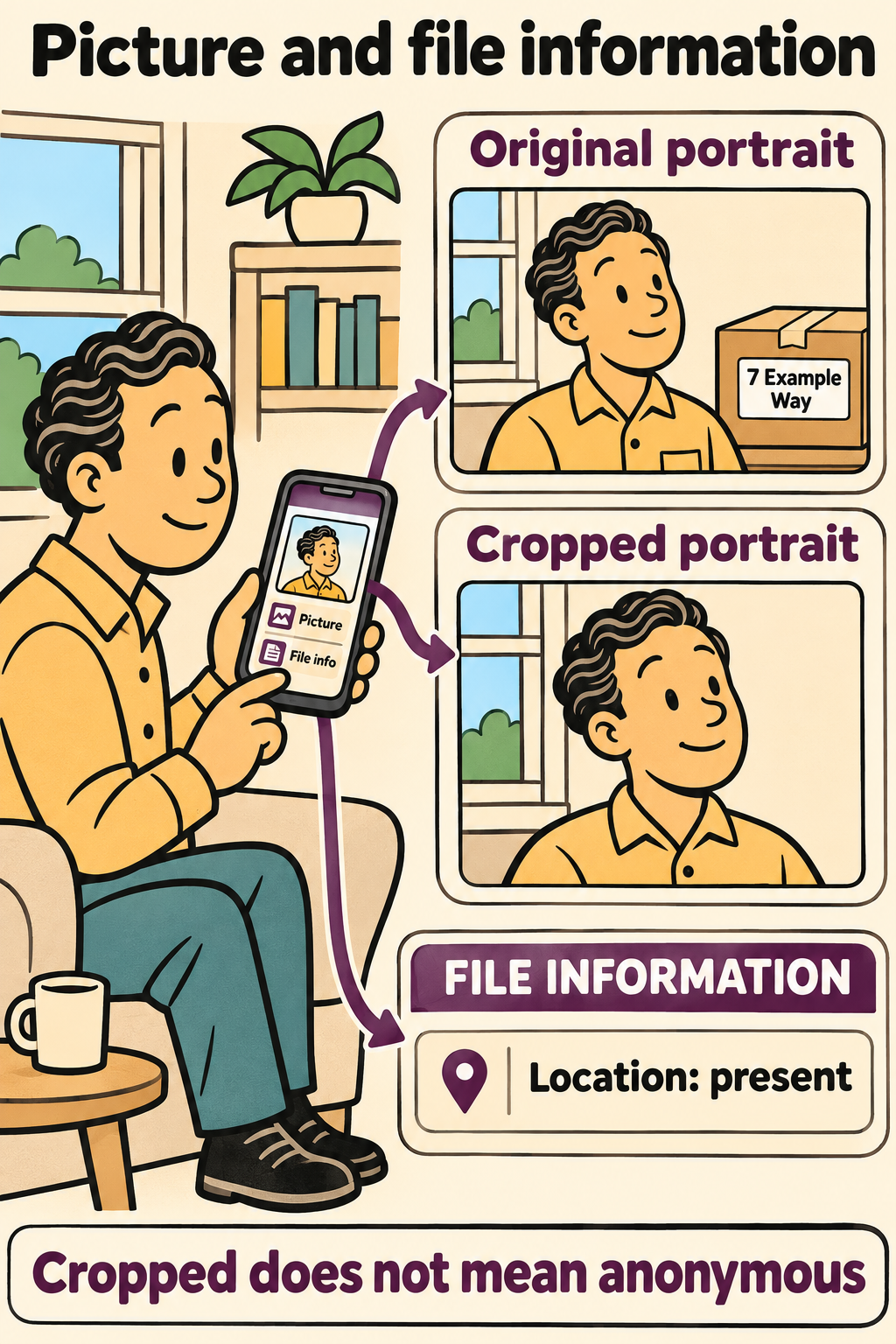
Before choosing Send, look past the person in the picture. Can you see a street number through the window, another person in a mirror, or a name on an envelope? A photo can also carry location data that you can’t see in the picture. Review both the image and its sharing information. Removing a location tag still leaves the street number in the window. Leave it unsent if you can’t be comfortable with what it reveals.
Ask about keeping, screenshotting and sharing separately. “I’d like to send this just for tonight. Are you happy to delete it afterward and keep it between us?” Only send it if the answer and the remaining risk work for you. A timer can clear a chat while a screenshot, a copy on another device or a photo of the screen survives. On the receiving end, keep the agreement even if the picture is spectacular. Especially then.
A QUICK NOTE TO YOURSELF
Choose your own invitation
Optional. Keep your notes private.
- Write one thing you’d enjoy sending and one kind of message you’d like to receive. They can be different. If someone asks for more, what alternative would you genuinely like to offer?
Look past the subject
Optional · At your own pace
- Hold an empty picture frame, or make one with your hands, around an everyday object. Find one detail at the edge of the imagined picture you wouldn’t want a stranger to see. Change the framing and check again.
- If you already have a harmless photo, you can inspect its information or sharing options without sending it. Notice which things live in the picture and which are attached to the file.
Use the lesson illustration or imagine a window with a street number outside it. You can do the exercise without handling a camera or making a recording.
With a partner
Try a one-line spoken message in person if you both fancy it. Let the listener choose whether they prefer that line written or spoken.
Take with you: Choose the format you both want and check what it would reveal before it leaves your hands.
Sources & further reading
10 · When a line lands sideways
Lesson notes
Recognize three different awkward moments and find the reply that fits each one.
You send “I know a good way to keep you up tonight.” The reply comes back, “Coffee?” You may be flirting with the driest wit alive. You may also be flirting with someone who really does want coffee.
Give a flat joke somewhere soft to land
When the meaning genuinely got lost, plain language will do. “I was flirting. Badly, apparently. I wanted to say I’m thinking about sleeping with you.” Use that bolder clarification only in a conversation where you’ve both welcomed that kind of talk. A shared laugh can put you right back where you wanted to be.
Sometimes the line was clear and the style missed. “Tell me what you want. Right now.” They reply, “I like talking about that, but can we lose the orders?” There’s your edit. “Sure. I’ve been thinking about sleeping with you. What’s been on your mind?” You can be the person doing the redirect, too. “I like it when you tell me what you want. The bossy thing doesn’t do much for me.”
When it actually hurt
If the reply is “Please don’t call me that,” drop the word. “Sorry. I won’t use it again.” Resist the urge to send a paragraph about what a perfectly decent person you are. They’ve asked for a change they should be able to feel on the very next turn. If they want to stop, finish there. If they offer a word they like, use it only if you both want to continue.
A missed joke, a different taste and crossing a line call for different responses. You can laugh together at the first. You can adjust to the second. Take responsibility for the third. Trying to make somebody laugh their way out of a genuine objection usually leaves them doing all the work.
A QUICK NOTE TO YOURSELF
Make the repair fit
Optional. Keep your notes private.
- Which tends to happen when you feel embarrassed: explaining too much, joking again, or vanishing? Write the one sentence you’d want to have ready if someone said a word had hurt them.
Choose the next line
Optional · At your own pace
- Imagine receiving three replies in turn: “Wait, was that flirting?”, “Less teasing, please,” and “That upset me. I’m done.” Give each the kind of response it asks for.
- Read your last response again. If it asks the other person to reassure you, shorten it until the requested ending feels easy to take.
Read the examples and select a response in your head if speaking or improvising feels uncomfortable.
With a partner
One person can choose a fictional reply. The other gets one ordinary sentence to respond before swapping roles.
Take with you: Clarify a misunderstanding, change a tone that misses, and take a boundary seriously.
Sources & further reading
11 · Keep a private exchange private
Lesson notes
Reduce unintended exposure and respond differently to a mistake, an unwanted post or a threat.
Perhaps your lover enjoys seeing your name light up on their phone. You may both be rather less keen on the message underneath it appearing on the family tablet.
Check who can see it
Use the actual conversation header to check the person and the audience, especially when two people share a name or a group uses one person’s picture. A lock-screen preview, a linked device or a shared account can show more than you intend. Explore your own notification settings with an ordinary message. Ask your partner which times and formats work on their side. Either person can keep the most personal thought for a private conversation in person.
If a message goes to the wrong person, stop sending. Where available, try the app’s unsend feature promptly. Its limits vary, and the person may already have seen or copied it. A brief correction avoids repeating the content: “That was private and sent by mistake. Please delete it and don’t share it.” If someone else’s intimate information was included, tell that person what happened so they can make their own choices.
If someone shares it or threatens to
Sending an intimate image to one adult never gives anyone permission to show friends or post it. If someone shares yours without permission, the responsibility belongs to the person who shared it. Record the account name, post link, dates and report number. Request removal through the platform’s intimate-image abuse reporting process. In the U.S., the FTC’s resource below explains further options. StopNCII.org can help adults with eligible images taken when they were adults by creating a fingerprint on their device for participating services.
If someone threatens to share an image unless you pay or send more, stop engaging. Don’t pay or send more material. Preserve the threat messages and account details, report the account, then block it. A trusted person can sit with you while you do that. For an image of yourself taken before age 18, NCMEC’s Take It Down can help even if you’re an adult now. Never download or forward such an image to make a report. Neither removal services nor a sender can guarantee that every copy is gone.
A QUICK NOTE TO YOURSELF
Make one privacy choice with a partner
Optional. Keep your notes private.
- How would you like a lover to handle an intimate message after the conversation? Write a request that makes your preference clear about keeping it, showing anyone else or deleting it.
Run a harmless privacy rehearsal
Optional · At your own pace
- With a harmless message such as “tea at six,” inspect the recipient name and the other members, if any, of a sample or existing chat. You can do this without sending anything.
- If you have your own linked devices, look at where an ordinary notification already appeared. Choose one place where you’d like fewer details to show. On paper, sketch the same exercise using a phone and a shared tablet.
Use fictional names and draw two message headers on paper. Mark which is a one-to-one conversation.
With a partner
Each person can describe where ordinary messages sometimes appear and one change they’d like for private chats.
Take with you: Check the audience before sending. If someone violates your privacy, support and reporting options are available.
Sources & further reading
- [5] Apple · Access features from the iPhone Lock Screen
- [6] Apple Support · How to unsend messages on your iPhone
- [7] U.S. Federal Trade Commission · Image-based abuse and support
- [8] eSafety Commissioner · Dealing with sexual extortion
- [9] StopNCII.org · How it works
- [10] National Center for Missing & Exploited Children · Take It Down
12 · Leave them with a good last line
Lesson notes
Bring a flirt to a satisfying finish and decide whether there’s a thread you’d both enjoy picking up another day.
It’s possible to have a thoroughly indecent ten minutes, make your lover grin and still get a decent night’s sleep. The trick is knowing when you’ve already sent the good ending.
Read a whole exchange
Jules: “I’m home. Feel like flirting for a bit?”
Kit: “Very much. I’ve got ten minutes.”
Jules: “I’m wearing your shirt. It’s the only bit of you I brought home.”
Kit: “I like the idea of you in my shirt. Tell me what you want when I get there.”
Jules: “Honestly? I want you to take it off me.”
Kit: “Slowly?”
Jules: “Very. And that’s the thought I want to fall asleep with.”
Kit: “Then you keep the shirt. Sleep well, gorgeous.”
See what happened to the shirt? It started as an ordinary detail. One person said what they pictured, the other supplied a wish, and a one-word question settled the pace. The last reply noticed the wish to finish and picked up the opening detail. That little return can make a goodbye feel as personal as the flirt.
Give the real ending
If you’re delighted and done, say both bits. “I loved hearing that. I’m putting my phone down now. Goodnight.” You can also finish because the bus arrived, you’ve lost the mood or you simply want to. A plain “I’m going to stop here” will do. When someone ends an exchange, let the goodnight stand. Sending one last sexual line after that takes away their choice about where it finished.
For an ongoing lover, an ordinary message next day can be a lovely souvenir. “I was still smiling over our chat when I made coffee.” If you want another round, give them a fresh invitation. If you meant that story for the phone alone, you can say that too. The two of you already made something enjoyable together. It can end exactly there.
A QUICK NOTE TO YOURSELF
Find your goodnight
Optional. Keep your notes private.
- Choose one detail you liked in an imagined exchange. Write an ending that remembers it and says whether you’re finishing for tonight or asking about another day.
Give the thread two endings
Optional · At your own pace
- Read the shirt exchange aloud or silently. At “Slowly?” try finishing as someone who’s happy and ready to sleep.
- Rewind to the same spot. This time imagine the mood went away. Try an ending you could actually use. Give each version a reply that lets it be the last message.
Pick a line from the example and decide where you’d stop reading or replying. No live conversation is required.
With a partner
Trade a short fictional thread and hand the ending to a different person the second time through.
Take with you: A good last line lets someone feel wanted and lets them put the phone down.