
PLEASURE SCHOOL · PUBLIC REVIEW
Paying for Sex
What money can buy, and what takes a yes
Review draft · Version 3
Maybe you’re curious about having someone’s full sexual attention for an hour. What are you hoping for? What does the other person actually offer? Learn to talk about desire, time and money with your clothes on, and to keep listening after they come off.
Twelve lessons with solo and partner practices, two original illustrations and 36 optional quiz questions.
Choose a lesson
- What are you hoping the money changes?
- Know which service and which law
- Let the professional tell you what they enjoy offering
- Talk about the money before the mood takes over
- Ask for the touch you mean
- Tell your own story
- Let the plan change in the room
- Say what the barrier is for
- Know when to walk away
- Take the real question home
- End on a good note
- Two encounters, two quite different pleasures
01 · What are you hoping the money changes?
Lesson notes
Put the desire into words before deciding whether a paid experience is even the one you want.
“I’d love an hour of someone’s undivided attention.” A friend hears that and suggests a therapist. Another suggests a date. You were rather hoping somebody would take your clothes off. It helps to mention that part.
Name the bit you keep thinking about
Maybe what you crave is sexual touch from someone who enjoys giving clear directions. Maybe you’d like to say, out loud, “I’ve never done this before,” without worrying what happens on a second date. Somebody else might like the idea of an appointment with a beginning and an end. Those wishes can overlap. They also make different demands on another person.
Try describing a moment instead of a result. “I want to be irresistible” leaves somebody else in charge of how you feel about yourself tomorrow. “I want somebody to take their time undressing me, with room for me to laugh if I get shy” tells you what you hope the experience would feel like. That’s a desire you can name even if you never act on it. Someone else is free to say whether it’s theirs to offer.
Sex, a lesson, or the pleasure of imagining it?
Suppose the fantasy is being guided through a first experience. Do you want a lover’s hands on your body? Do you want an educator to show you something on a model while you ask questions? Or do you enjoy the story most when you get to cast every role yourself? Knowing which part you want saves you from sitting through a very fine lecture wondering when your shirt comes off.
A sex worker can offer skill, kindness and sexual attention within the work they choose and are permitted to do. No one can sell you the certainty that you’ll fall in love, have an orgasm or feel better tomorrow. A sex therapist can help you work through a worry about sex. Sexual contact with a client crosses the therapist’s professional boundaries. If you’d like help with anxiety and a sex life you enjoy, you can name both wishes.
A QUICK NOTE TO YOURSELF
Write the part you mean
Optional. Keep your notes private.
- Finish “The part I keep imagining is…” with one moment another person could picture. Circle the part you could ask about and underline anything that would have to come from your own feelings.
Hear your desire in your own voice
Optional · At your own pace
- In private, say or sign your sentence once as if the listener already likes you and has plenty of time. Give yourself permission to use an ordinary adult word for the touch or attention you mean.
- Now try it as a fantasy you’d enjoy keeping to yourself. Notice which version makes you curious, relieved or uncomfortable. That is enough information for today.
You can rehearse silently, type in a private note, or choose a word or symbol on your communication device. No disclosure or sexual participation is needed.
With a partner
By agreement, share a fictional wish. Ask the listener to say what they heard you wanting. Talking about a paid fantasy with a lover is a conversation, and either of you can leave it there.
Take with you: A fantasy can tell you what you like even if it never leaves the pillow.
02 · Know which service and which law
Lesson notes
Tell a paid sexual encounter, a class, and a recording apart, and check the law for the actual activity and place.
Picture three receipts. One says “workshop,” one says “film,” and one simply says “time.” Which tells you whether one adult has agreed to have sex with another? You’re going to need rather more than the stationery.
Start with what the adults would actually do
A teacher can use a silicone model to demonstrate where the clitoral hood is while students keep their hands on their own notebooks. A creator can make a consensual adult film and offer lawful access to watch it. In-person sexual services involve an adult offering sexual activity with another person for compensation. These are different activities with different rules. Whether a service is lawful depends on its particulars and its jurisdiction.
Here in Louisiana, R.S. 14:82.2 prohibits knowingly giving, agreeing to give, or offering anything of value for sexual intercourse as defined in the law, including oral, anal and vaginal intercourse. Read the current statute for its full wording. Giving the payment a softer name doesn’t change the underlying offer. If the intended exchange is prohibited, leave it there. A class with a model is an option if what you genuinely want is education.
Two places, two different answers
In New Zealand, adult commercial sexual services are decriminalized under a law that sets conditions on who can do the work and how. A worker can refuse or stop even after signing a contract. Section 9 also requires worker and client to take all reasonable steps to use an appropriate barrier for oral, anal or vaginal penetration and other activities carrying a similar or greater STI risk. The people in our New Zealand examples meet in circumstances the law permits. Those rules don’t travel home to New Orleans with you.
For your own situation, start with the place and what people would actually do. Look at the current official law there. If you’re still unsure how it applies, a qualified local professional can advise you before you act. And the film on that second receipt? You’ve paid for the uses its terms allow. It gives you no claim on the creator’s time or body.
A QUICK NOTE TO YOURSELF
Translate the receipt
Optional. Keep your notes private.
- For each of three imaginary purchases, jot down what actually happens: a model-based class, access to a lawful adult film, and paid in-person oral sex. Which would require looking up the local law about purchasing sexual services?
Read the law one verb at a time
Optional · At your own pace
- Open the Louisiana statute in the sources or use a screen reader. Find the three actions in the first provision: giving, agreeing to give and offering to give. Match an imaginary offer of money for oral intercourse in Louisiana to that wording.
- Then open the New Zealand source and find section 17 on refusal. Practice explaining to someone what each source answers and where its answer applies. You can complete the exercise using the summaries above.
Use the plain-language summaries, voice dictation or a conversation with a trusted reader. A short sentence per example is enough.
With a partner
One person describes a fictional class using a model. The other changes one detail so it becomes a proposed exchange of money for sexual intercourse. Identify why the legal question changes. No real proposal is part of this rehearsal.
Take with you: Ask what would happen and where. A fancy label answers neither question.
03 · Let the professional tell you what they enjoy offering
Lesson notes
Hear a worker’s offer clearly and decide whether the experience appeals to you both.
You’ve spent twenty minutes trying to sound like someone who has done this before. The first thing the person opposite you says is, “Hi. What would you like me to call you?” Good news. You know this one.
Listen for the part they chose
People who do sex work have their own ways of working. One might love a slow, flirtatious build. Another might say, “I’m quite direct. Tell me what you’re hoping for and I’ll tell you if it’s something I offer.” Neither owes you a different personality to suit the picture in your head. Use the name and terms the person gives you. You can tell them what you like to be called, too.
Imagine a lawful adult session. Robin, the worker, says, “I love taking the lead. I’ll tell you when I want you closer.” Their client, Viv, had pictured the opposite. “I like giving directions, too. How would that work?” Robin gives it a moment. “Tell me where you like to be touched. I’d still like to be the one who starts.” That suits Viv. Now they know what taking the lead means to each of them.
Take the answer without making them rescue the mood
Sometimes the offer is too far from the wish. Viv might be keen on kissing and Robin might say, “Kissing’s something I keep for my own life.” A warm “Thanks for telling me. I think we want different things” gives them both a graceful way out. No need to ask what it would cost to be the exception, try a kiss as a joke, or ask Robin to explain their private life.
There’s pleasure in taking a yes seriously, too. If Robin offers an unhurried shoulder massage as part of this adult sexual encounter, Viv can say, “Oh, yes. I like it when you use your whole hand.” A worker may mean every affectionate word they say on the job. They can also be doing their job beautifully. You can enjoy that warmth without asking them to prove they were turned on, too.
A QUICK NOTE TO YOURSELF
What can you actually hear?
Optional. Keep your notes private.
- Imagine someone saying, “I like giving directions. I don’t kiss at work.” What have they told you about the experience? What are you tempted to invent about their private life? Leave that second part out of your reply.
Try a graceful answer out loud
Optional · At your own pace
- Say “I’d like to be kissed” in your own words. Now imagine hearing “I don’t kiss at work.” Give a short answer that leaves the decision settled. Try it again without an excuse, an extra offer or a nervous joke.
- For the second round, hear “I do enjoy giving a shoulder massage.” Try an answer for the version of you who wants that and one for the version who still wants the kiss enough to decline. Notice which answer feels honest.
Use signing, a communication device, a saved phrase or a voice note. Give a short answer all the time it needs.
With a partner
Take turns voicing one preference you’re happy to share and one limit. The listener gets to ask about the appealing part or say it’s a mismatch. The speaker can keep their reasons private.
Take with you: A clear offer is much easier to enjoy than an exception you have to talk someone into.
Sources & further reading
04 · Talk about the money before the mood takes over
Lesson notes
Say what you can spend, find out what the fee covers, and recognize when a money question needs a separate conversation.
A client can say “I’d like you to undress me” without blinking and still go bright pink at the words “What does the hour include?” Money has an impressive knack for finding the last shy bone in the body.
Put the clock in the room
In an adult appointment that’s lawful where it takes place, the price may cover a period of the worker’s professional time. Ask what that means in this particular agreement. “Is the time we spend talking at the beginning part of the hour? When do we need to be dressed and done?” If the answer includes time to talk, change and say goodbye, plan for exactly that. A leisurely ending can be worth keeping ten minutes for.
Decide what you can comfortably spend before you’re sitting opposite someone charming. “The longer session is outside my budget” is a whole sentence. You can decline without haggling over someone’s worth or promising to stretch yourself thin. The worker can decline a shorter session. Ask how cancellation, ending early and any fee questions are handled. If what you’d owe still isn’t clear, wait. Nobody benefits from discovering two different understandings over one receipt.
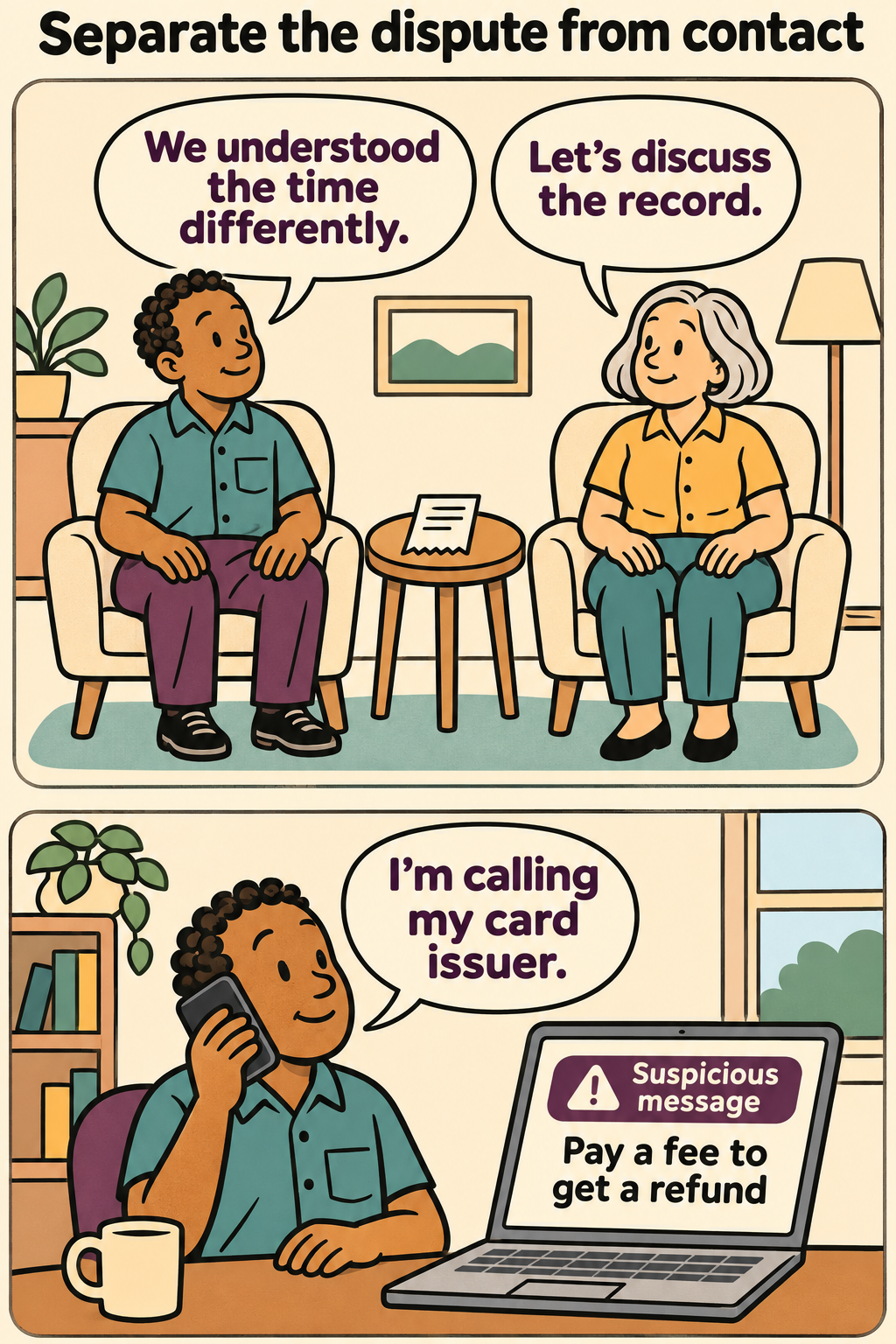
A disagreement is one thing. A stranger promising a refund is another.
Suppose the appointment ends early. Sexual contact is finished as soon as either person wants it finished. Later, one person says, “I thought part of the fee would come back,” and the other remembers the terms differently. Look at the actual agreement and, if needed, seek appropriate consumer or local legal advice. You can question a charge without accusing someone of fraud. You can also refuse further contact while a fee question remains open.
Then a stranger messages you. They say they can recover the money if you pay them first. That’s a warning sign of a refund scam. The worker from the appointment may know nothing about it. Skip the link and the extra payment. If you sent money to the stranger, or spot a charge you didn’t authorize, reach your payment provider through its official app or the number on your card. Tell them which happened. If you authorized the original charge but dispute the terms, say that plainly, too. The issuer can explain what options you have in each case.
A QUICK NOTE TO YOURSELF
Decide what the time is for
Optional. Keep your notes private.
- Imagine a lawful appointment with a fixed ending. Would you rather keep a longer hello, more time for an agreed experience, or a few comfortable minutes at the end? Write the question you’d ask about the clock.
Say the number without explaining your life
Optional · At your own pace
- Pick a fictional spending limit for a service you could decline. Say, sign or type “That’s beyond what I want to spend” and stop there. Notice the temptation to add a long speech about your bank account.
- Now rehearse receiving that sentence as the professional. You can say what your existing terms are, accept the mismatch, and wish the other person a good evening. Neither side needs to offer a different kind of touch to balance the books.
Use a calculator, a written outline or a trusted person who helps you communicate if you choose. Keep your actual finances and account information out of this exercise.
With a partner
Take turns playing two adults who remembered an end time differently. Keep the encounter finished and practice talking just about what was agreed. Then identify how a later message demanding a recovery fee would change your response.
Take with you: You can have a money conversation with everybody fully dressed.
05 · Ask for the touch you mean
Lesson notes
Make a request either adult can answer, using a way of communicating that works throughout the encounter.
“Can I kiss you?” “Where?” Fair point. One of you had a shoulder in mind. The other has just very thoughtfully removed their glasses.
Give the other person room to answer
In a lawful paid encounter, start with a specific contact that’s on offer. “Would you like me to kiss your shoulder?” tells the other person who would do what and where. They might say “Yes, on the left,” offer their upper arm instead, or say “I’d rather just talk for a minute.” Leave enough space to hear the answer before moving in. A shoulder presented with a delighted yes makes a much better beginning than somebody ducking a kiss while trying to explain.
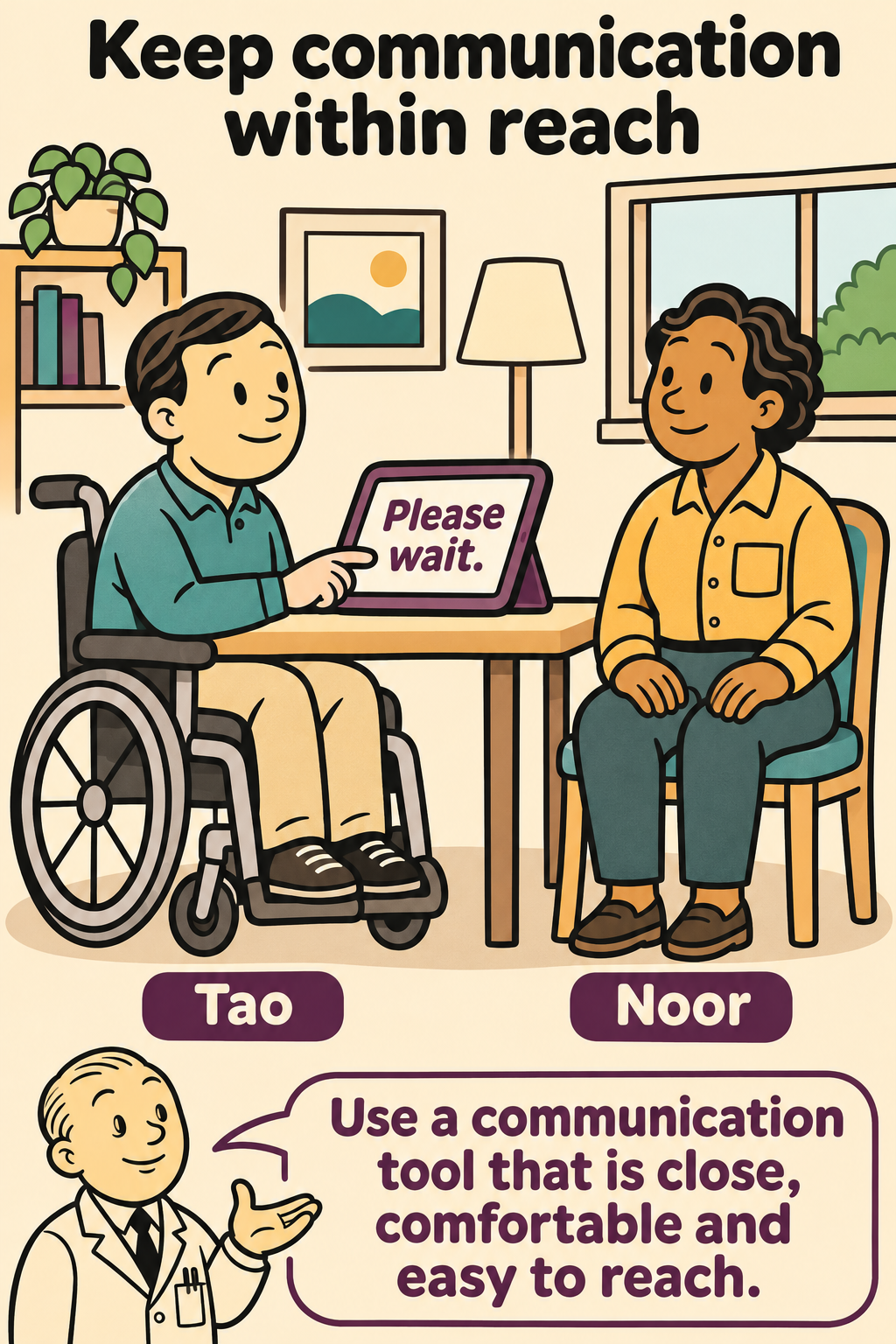
The person answering might use speech, signing, gestures or a device. In the drawing, Tao’s tablet says “Please wait.” Noor waits. The tablet stays with Tao, even if it’s resting exactly where Noor pictured putting an elbow. If someone brings a friend or an interpreter, keep talking to the person you’re asking. They choose whose help they want and give their own answer. Ask where they need the device and how you’ll notice a stop signal once your hands are busy.
Give a yes somewhere to go
Imagine the client wants the worker to take the lead in undressing them. The worker offers to unbutton their shirt and touch their upper chest. “Yes to both. Leave the shirt on my shoulders, though?” The worker opens the buttons, leaves the shirt where the client wants it, and rests a hand on their upper chest. “That weight feels lovely. Stay there.” Now the worker knows which bit the client wants to linger over.
If either of you fancies a different touch, ask about it. People can be excellent at what they do and still be unable to read minds. If the tablet slips out of reach or the person signing can no longer see your face, stop touching and make it easy to communicate again. Give them time to answer for themselves before you do anything else.
A QUICK NOTE TO YOURSELF
Replace “whatever you like”
Optional. Keep your notes private.
- Try writing one request that includes a body location and who does the touching. Give the other person an ordinary way to suggest something else. Include a boundary that you would want heard.
Practice the space after the question
Optional · At your own pace
- Settle comfortably with your usual way to communicate in reach. Ask aloud, sign or type a request for a simple touch you could imagine wanting. Put your hands at rest while you leave time for an answer.
- Try three answers from the other role. A yes to the touch you asked about lets you try that movement. An offer of a different spot gives you something to agree on before moving. For “wait,” keep your hands at rest. You can rehearse all three on your own, fully clothed.
A saved phrase or a familiar gesture can make timing easier. Check that either adult can use their own stop signal and that the other can receive it once the activity begins.
With a partner
Pick an ordinary, optional hand or forearm touch. One person asks, the other answers in their usual way, and both try an unhurried pause. If there’s a particular yes, use just the agreed contact. After “wait,” keep your hands to yourself.
Take with you: A little specificity leaves room for a much better yes.
06 · Tell your own story
Lesson notes
Decide what can be said, saved or shared without taking another person’s privacy along for the ride.
Your best friend texts, “How was it? Tell me everything.” You’re still smiling. You also know “everything” would include someone else’s face, body and working life. Start with the smile.
A lovely moment can stay in the room
An ordinary phone causes an extraordinary amount of ambiguity in a private appointment. You might need it to speak, read a message, check the time or arrange a ride. Say what you’re using it for and keep anything that records switched off. The person who needs a device to communicate keeps it. Helping somebody use a screen gives you no reason to look through their messages or take a picture of them.
Permission to touch is separate from permission to film, take a photo, save a message or share it. If one of you says “I don’t want a record of this,” put the camera away. What if the memory you want to share is a performer’s adult clip you bought? Check the viewing terms. Buying viewing access alone doesn’t transfer the copyright or give you permission to send copies to friends. Once an image has been shared, neither person can promise to retrieve every copy.
You can tell someone how you felt
“I was nervous, then I found the nerve to ask for the touch I wanted” is a good story about you. Adding the worker’s personal name, distinctive tattoo, private address or an identifying photo turns it into a story about them. If you’re considering a public review, check whether it’s welcome at all and what details the person has chosen to make public. Keep a work name in its work context. Recognition in the grocery aisle isn’t an invitation to say how you met.
Discretion still leaves room to get help. With a clinician, you can say, “I had vaginal sex last night and the condom broke. What should I do now?” If something frightened or hurt you, you can say so and get support. A personal partner may need to know about a broken agreement or a possible exposure to make their own choices. You can give the facts that matter in each conversation, including anything you need to say to get care.
A QUICK NOTE TO YOURSELF
Try the friend’s question
Optional. Keep your notes private.
- Write one sentence you could send a trusted friend about how you felt. Read it once for details that would let someone recognize the other person. Keep the part that’s yours.
Choose what to say in each room
Optional · At your own pace
- Imagine answering “How was it?” three times: to a curious friend, a personal partner affected by an agreement, and a clinician asking about a broken barrier. Say a first sentence for each. Use fictional details.
- Listen for what changed. Your friend can hear about your nerves, your partner may need to know what you actually did, and the clinician needs the type and timing of contact. Which details can stay private across all three conversations?
Use a communication device, signing or a trusted interpreter of your choice. Privacy includes being able to decide who helps, what they see and when you’d like them to step away.
With a partner
Agree on a completely fictional story. One person asks for a photo or an identifying detail. The storyteller gives a warm answer about their own experience and leaves the other person’s details private. Switch roles.
Take with you: “I’ll tell you how I felt” can be a generous answer.
Sources & further reading
- [9] Federal Trade Commission · Options when someone shares an intimate image without consent
- [10] U.S. Copyright Office · Ownership of copyright and ownership of a copy, 17 U.S.C. §202
- [6] American Speech-Language-Hearing Association · Augmentative and alternative communication
- [13] CDC · Asking about STI testing, including throat and rectal testing
07 · Let the plan change in the room
Lesson notes
Respond when either person wants to change or end something that sounded good earlier.
At home, the words “a very bossy countess” sounded magnificent. Hearing them addressed to you by a splendidly convincing professional, you would give a great deal for the countess to call you by your own name.
Come out of character first
Suppose two adults have agreed to a paid, lawful role-play encounter. The client wanted a strict, flirtatious character. Now the worker notices the client has stopped answering. Drop the character and take your hands away. “It’s me. Want to stop?” is much easier to answer than a question delivered by imaginary aristocracy. If there’s no clear, freely given answer, the scene ends.
If you’re the client, you can take that step yourself. “I like your company. I don’t want to be ordered around anymore.” Someone can be very good at their work and still hear that sentence. The worker might be glad to spend the remaining time talking as themselves. They can also say that the session is over. Asking for a change leaves the other person a choice about the new idea.
Hear the worker’s change, too
Now imagine the worker is the one who wants to stop. “I’m done with touch today.” Take your hands away. You can be disappointed and still make their next thirty seconds easy. “Okay. Would you like me to give you some space?” Then listen. Offering more money for the same touch simply gives them the job of refusing twice.
A past yes, a booked hour, or a fee already paid can make someone feel awkward about speaking up. None commits either adult to more bodily contact. If there’s a real question about a cancellation term, take it up through the agreed professional channel after contact has stopped. Give the person saying stop what they need now, without making them settle the bill or promise a replacement activity first.
A QUICK NOTE TO YOURSELF
Give yourself a usable exit line
Optional. Keep your notes private.
- Choose a detail you might genuinely change your mind about, such as a role, a word or a kind of touch. Give it one sentence you could say in the middle of the moment.
Step out of the part
Optional · At your own pace
- Try a playful fictional greeting in character. Halfway through a second try, drop the role, sit back or move one hand away, and say that you want the scene to stop. Notice what helps you hear the change in your own voice.
- Now play the person receiving the request. Put down anything in your hands, make space, and answer in an ordinary voice. Let that answer end without an offer or a counterproposal.
Use a preselected text, card or gesture for “stop and speak as ourselves.” Have the other person show they can notice it with hands and eyes in the position you plan to use.
With a partner
Take turns changing a small, agreed detail in a clothed scene, such as dropping a formal title. The listener pauses and answers as themselves. If both want the new idea, start it fresh.
Take with you: You can retire a countess in the middle of her best line.
08 · Say what the barrier is for
Lesson notes
Match protection to the actual sexual contact and know what to do if that protection changes.
You can practice putting a condom on a model and still go a little blank the first time a real person asks, “Have we got the kind that works for you?” Fortunately it’s a question you’re allowed to answer in your everyday voice.
Name the touch before reaching for the packet
Imagine a lawful paid session. The worker says, “I’m happy to go down on you with a dam.” The client admits, “I’ve never used one. Can I see it first?” Of course. They look at the thin sheet together, then decide whether that’s the touch they want. If someone shows you a barrier on a teaching model in a class, the demonstration stays on the model. The question here is what these two adults have chosen to do together.
For oral contact with a vulva or anus, put a fresh dental dam over the area before mouth contact. Keep the same side facing the body throughout. For oral contact with a penis, start with a fresh external condom. Use a fresh barrier for each act. An intact barrier used correctly reduces STI risk, although some infections can spread through contact with uncovered skin. The worker’s profession can’t tell you whether either person has an infection.
When something changes, stop the touch
Suppose you’ve agreed to intercourse with a condom. Halfway through, it slips off. Stop, ease apart and tell the other person what happened. Neither of you agreed to unprotected contact. Discard the used condom and decide what each of you needs now. If you both want to continue, deal with the fit or friction first and use a fresh condom. Water-based lubricant is compatible with latex. Either of you can call it a day.
If there may have been an exposure, contact a sexual-health clinician promptly. Tell them when it happened, which body parts had contact and what happened to the barrier. That helps them choose the right tests and discuss emergency contraception if pregnancy is possible. For possible HIV exposure, seek care right away. If HIV post-exposure prophylaxis (PEP) is indicated, CDC recommends starting as soon as possible, ideally within 24 hours and no later than 72 hours after exposure. Even after 72 hours, you can still get advice and testing. A test today can miss a recent infection, so ask when to come back.
A QUICK NOTE TO YOURSELF
Give the awkward sentence a rehearsal
Optional. Keep your notes private.
- Pick a line you’d be glad either person said if a barrier slipped. Include what you noticed and what you want to do immediately.
Try a barrier change with your hands free
Optional · At your own pace
- Use an unopened practice packet or an ordinary envelope to stand in for one. Set a clean place within reach for a fresh barrier, separate from anything used. Rehearse stopping your movement and saying what changed before reaching for a replacement.
- If you have a dental dam, read its instructions and try positioning a fresh one on a practice model. If you have a condom instead, follow its instructions on an appropriate model. Discard a barrier opened or used for practice. The exercise also works with an empty packet and a spoken walk-through.
Use the communication method you rely on for health decisions. Arrange packets where a free hand can reach them, or ask the other person to handle the packet while you both pause.
With a partner
With clothes on, one person says, “Hang on, it slipped.” Both pause. Let the other person choose whether they want to discuss a fresh barrier or finish. Give them an easy chance to say either.
Take with you: The first useful words can be as simple as “Hold on a second.”
Sources & further reading
- [2] New Zealand Legislation · Prostitution Reform Act 2003, especially sections 7, 9, 16 and 17
- [11] CDC · Condom use and protection against sexually transmitted infections
- [12] CDC · Oral sex, STI risk and barrier options
- [13] CDC · Asking about STI testing, including throat and rectal testing
- [14] CDC · 2025 U.S. recommendations on HIV postexposure prophylaxis
09 · Know when to walk away
Lesson notes
Tell an ordinary professional limit from pressure that takes someone’s choice away.
“I don’t tell clients where I live.” You have learned exactly one thing about this person. They don’t tell clients where they live. You can take them at their word and keep your detective hat for fancy dress.
An ordinary boundary can be quite boring
A worker might use a work name, keep firm hours, decline kisses or end a conversation that has become personal. They can decide all that for themselves. People of any gender, accent or background might earn money this way. A preference for privacy, the use of a communication device, speaking through an interpreter by choice or being paid tells you nothing by itself about coercion. Look instead at what is happening to someone’s ability to choose.
Now imagine hearing “I told them I didn’t want to do this” while someone blocks the doorway or threatens to take the person’s earnings unless they carry on. Stop the encounter. Under U.S. federal law, inducing an adult to perform a commercial sex act through force, fraud or coercion can be prosecuted as sex trafficking. For commercial sex involving anyone under 18, federal law doesn’t require proof of those means. You can get to safety and seek help without having to prove what crime took place.
Help without taking over
If you can safely listen, make the offer small. “Would you like me to call someone you choose?” Give the person room to answer, including no. Avoid confronting whoever is making threats, taking pictures for evidence or promising a rescue. Those moves can leave someone with consequences long after you have gone home. If someone is in immediate danger, get to safety and contact local emergency services. In the U.S., the National Human Trafficking Hotline can offer guidance about concerns when it’s safe to reach out.
A client who threatens to tell a worker’s family unless they agree to sex is using fear to get contact. A client threatened with exposure unless they accept unwanted touch has just as much right to stop and seek help. Compare that with “I remember us agreeing to a different fee.” You can discuss what you owe through the usual dispute process. Nobody owes sexual contact to settle the difference.
A QUICK NOTE TO YOURSELF
Hear the choice in what someone says
Optional. Keep your notes private.
- Compare “I prefer to have my colleague nearby” with “I’m not allowed to leave.” What ordinary boundary does the first sentence express? What would you do on hearing the second if it was safe to act?
Try three different replies
Optional · At your own pace
- Read these three lines aloud or on a screen: “I keep my address private.” “I don’t want to continue.” “They said they’ll hurt me if I leave.” Pause after each and choose a first response that fits the actual words.
- Try your responses in an ordinary voice. The first can get a simple acknowledgment. The second ends the activity. The last calls for attention to immediate safety and appropriate help. Notice which reply gets shorter when you leave out demands for proof.
Read or rehearse silently. Skip any scenario that feels too close to home. A one-word reply such as “okay” or “stopping” is useful practice for the ordinary boundary examples.
With a partner
Practice with the first two neutral lines only. One person states a professional limit or ends the fictional session. The other acknowledges it without asking for personal history. Switch roles if you both want.
Take with you: You can respect someone’s privacy and still take a direct report of danger seriously.
10 · Take the real question home
Lesson notes
Talk with a personal partner about desire, existing agreements and anything that affects their own sexual choices.
There’s a world of difference between “I’ve been thinking about paying for sex” and “I did something last Thursday.” If the second one is true, don’t send the first one in wearing a small false moustache.
Give curiosity its own conversation
If you have a personal partner, start by sorting out what you actually want to discuss. A fantasy? Something you’re considering doing? Something that has already happened? Choose a private time when neither of you needs to be out the door in five minutes. “Can I tell you about a fantasy involving a paid encounter? I’d like to hear how the idea lands with you.” That gives someone a fair chance to say “Now’s good” or “After dinner, please.”
One partner might find the fantasy exciting and feel quite differently about a real encounter. Ask where the appeal or worry lives. “Is it hearing me describe it that feels good, or is this something you’d actually want in our agreement?” Listen for the answer instead of trying to improve it. Jealousy might be about broken trust, shared money, sexual health or simply feeling left out. Let the person who feels it tell you which. Follow the arrangement you actually have while any proposed change remains undecided.
When the event has already happened
Suppose you and your partner agreed to talk before either of you had outside sex, and you’ve already had paid sex. Tell them what happened and own the broken agreement. “I paid someone for sex last week. We said we’d talk first, and I didn’t. Do you want to ask me anything now, or would you like a minute?” Let them decide. The worker wasn’t the person who made and broke that promise.
Give a partner the health information they need to choose about sex with you before you next have it together. That may include the type of contact, whether the agreed barrier was used or failed, and what advice or testing you’re seeking. A clinician can help you work out timing. The other person’s work name, identifying details or photos rarely answer a health question. A partner is free to want a pause, time alone or further conversation. If you are single, you can still decide what information a future partner needs to make their own sexual-health choices.
A QUICK NOTE TO YOURSELF
Be clear about the tense
Optional. Keep your notes private.
- Pick one opening for a private conversation about a fantasy, a proposed change or an event that has already happened. Try it in one sentence and check whether a listener would know which of the three you mean.
Leave room for the answer
Optional · At your own pace
- Say your opening line out loud, in a message draft, or to a blank chair. Stop after the first sentence. Leave an unhurried beat for an answer instead of racing to explain why the other person ought to agree.
- Now try responding to “I’m not ready to decide.” Choose a sentence that lets the conversation pause without treating silence as permission. If you’re practicing a disclosure, choose how you’d respond to “I need some space.”
Use a written message if that lets you communicate more clearly. Arrange a private way to share it and enough time for the recipient to answer in their preferred way.
With a partner
You can rehearse with a harmless invented desire and an existing agreement, such as whether you make overnight plans together. One person asks to talk about changing the agreement. The other decides when and whether they want that discussion.
Take with you: Say which conversation you’re having while the other person can still choose how to join it.
Sources & further reading
11 · End on a good note
Lesson notes
Enjoy a warm goodbye, leave on time, and decide what belongs to you after a paid encounter ends.
Your shoes are on. The appointment’s over. You had a lovely time and now, for some reason, “I had a lovely time” feels too small to say. Try it anyway. How you say goodbye can be one of the nicest parts.
Leave time for the actual goodbye
A clear end can make a paid encounter feel more relaxed from the beginning. If an agreed ending matters to you, say so while there’s time. “I’d like a couple of quiet minutes to get dressed afterward. Can we leave room for that?” A worker can tell you how they like to close a session. They might offer water, a few words or simply privacy to gather your things. Personal care needs can be part of that conversation in advance.
As the agreed end approaches, wind the activity down. Don’t make the other person choose between watching the clock and looking after your feelings. A compliment about something they did can be both warm and complete. “I loved the way you let me take my time.” Give them a chance to say goodbye, collect your things and leave at the agreed time. A person can be genuinely delighted to hear that compliment and still have somewhere else to be.
Take the good feeling home with you
Later you may feel buoyant, a little tender, lonely, or surprisingly ordinary. The question to try over breakfast is “What did I enjoy about myself there?” Maybe you liked being able to ask directly for attention. Maybe being looked at without rushing felt wonderful. Those discoveries belong to you even when the professional relationship has a clear edge.
Suppose the worker said “I had a lovely time.” You can believe their words and let the goodbye stand. A work name stays a work name. Leave personal accounts, homes and chance encounters out of follow-up. Use only an agreed professional channel and purpose if a practical matter needs attention. If what you want is reassurance that you were special, give yourself a day to enjoy the memory. A trusted friend or counselor can listen to your feelings without needing the worker’s identity.
A QUICK NOTE TO YOURSELF
Keep the compliment short enough to say
Optional. Keep your notes private.
- Remember a time someone made you feel wonderfully at ease. Write one thank-you about the thing they actually did. Can it end there, with no question they need to answer afterward?
Try the last two minutes
Optional · At your own pace
- Set a short timer or choose a piece of music with a familiar ending. Do something quiet and pleasant on your own. As the end approaches, let the activity wind down, give yourself the last moment to settle and choose one kind thing to take into the rest of your day.
- Try saying a goodbye once while collecting your belongings. Listen for the point where you are tempted to add “and maybe we could…” just to stretch it out. Let your first warm sentence have the last word.
If dressing or transferring takes time, build that into your imagined ending. You can practice a final gesture, signed thanks or prepared message from your own comfortable seat.
With a partner
In a clothed rehearsal, agree when an ordinary handhold or shared conversation ends. One person thanks the other for a specific detail, then they part as agreed. Try a version that ends warmly without another invitation.
Take with you: A good goodbye gives both people the rest of their day.
12 · Two encounters, two quite different pleasures
Lesson notes
Follow one encounter from the client’s side and another from the worker’s, then name the part you would want to keep or decline.
One person wants to lie back and be the one who asks for more. Another likes being asked to watch. Put them in the same story without asking what either means by “more” or “watch” and you’d miss two very good afternoons.
The pleasure of receiving
In New Zealand, two adults meet for a paid sexual encounter in circumstances permitted by local law. Alex, the client, is used to looking after everyone else in bed. Today they want the pleasure of receiving oral sex on their vulva and being able to ask for the pace they like. Noor, the worker, enjoys giving oral sex with a dental dam and has agreed to that contact. There’s no promise about orgasm. Alex suspects that may be their favorite part already.
They get comfortable. Alex asks, “Could I keep my knees a little closer together?” Noor shifts to an angle that feels better for them, too, and places the fresh dam across the vulva before mouth contact. Through it, a gentle, steady contact beside the clitoral hood feels good to Alex. “There. Could you go a little slower?” Noor keeps the same spot and slows down. When Noor needs to lift away for a moment they do, and the dam stays in place. “Same again?” gets an unambiguous “Please.”
Later Alex feels satisfied and asks to finish, without an orgasm. “That slow bit was lovely. I’m ready to sit up.” Noor ends the contact, disposes of the used dam and gives Alex room to dress. At home Alex thinks about how rarely they’ve heard themself say “slower” without following it with an apology. That’s the moment they want to remember.
The pleasure of an audience of one
At another lawful paid adult session in New Zealand, Jules is the worker. They like taking a seat across from a client and giving that person their full attention. Today their client, Marin, wants to touch themself while Jules watches. It’s an intimate request. They agree on watching and a little conversation. No touching each other, photos or recording. Jules chooses a distance that feels comfortable to them.
Marin settles comfortably and starts with a familiar touch on their own body. After a moment they laugh. “I thought I’d want commentary. Would you just look at me?” Jules is happy with quiet. They stay in their chair. A little later Jules wants to know whether their gaze still feels welcome. “Still with me?” Marin looks up and smiles. “Yes. I love getting to look back.” What appeals to Jules is that moment of someone meeting their eye on purpose. They don’t have to turn it into a personal invitation after work.
At the time they agreed, Marin brings the touch to an end and gets dressed. Jules thanks them for speaking up about the quiet. If you were borrowing one detail from these stories, which would it be? Being able to direct someone’s attention? Getting to choose how much of yourself to share? You can take that answer into a conversation with a lover, keep it as a private fantasy or conclude “That sounded better in the story.” You’ve learned something any of those ways.
A QUICK NOTE TO YOURSELF
Borrow one detail, leave another
Optional. Keep your notes private.
- From either person’s point of view, name one part of these scenes you’d like and one you would decline. Write the short invitation or answer that makes both parts plain.
See what changes when you choose the audience
Optional · At your own pace
- In private, settle with one familiar touch you enjoy, over clothes if you like. Imagine choosing a specific kind of attention, such as quiet company or hearing a lover ask what pace you want. What happens to your comfort and interest when you picture that part?
- Drop the imagined audience and spend a moment on your own. If privacy feels best, give yourself the rest of the exercise in privacy. If the invitation still appeals, practice asking for just the detail you liked. No photo, paid session or partner is needed.
Use a spoken passage, sign or familiar sound in place of gaze or touch. Pick the form of attention you can enjoy and receive on your own terms.
With a partner
If being watched appeals to both of you, agree who’ll watch, where they’ll sit and whether you’ll talk. The person being watched can choose their own familiar touch, over clothes if they like, or simply sit and meet the other’s gaze. Either person can ask for quiet, more space or a goodbye.
Take with you: Choose the kind of attention you actually want to give or receive.