
PLEASURE SCHOOL · PUBLIC REVIEW
Cuddling
Find the hold you’d happily stay in
Review draft · Version 6
A quick hug in the hall, a long spoon on a rainy morning, a shoulder that happens to be free in a cuddle puddle. Learn how to settle into a hold, find out what each person likes about it and keep the good bit when somebody needs to move.
For adults. Every lesson has a solo option. For a little practice asking for what you want and hearing an honest answer, start with lesson 10.
Choose a lesson
- Come here for a hug
- The good corner of the sofa
- Spoon without sacrificing an arm
- Face to face, with room for noses
- Come rest your head here
- What does “hold me tighter” mean?
- What should the hand do?
- When one of you is a furnace
- Let the usual holder be held
- A cuddle can stay a cuddle
- Find your place in a cuddle puddle
- Stay, shift, or let go
01 · Come here for a hug
Lesson notes
Offer a hug the other person can step into, shape and leave.
The person you’ve missed is finally in front of you. You’ve got two arms and a very good idea.
Let them meet you
“I’m so glad to see you. Hug?” Leave the last bit of distance for their answer. Once you have a yes, open your arms and come close enough that neither of you has to tip forward. Angle your heads past one another. Let your hands land on the part of the back they welcome. There’s that lovely moment when the greeting becomes a hold and both of you realise you can linger.
Try keeping your feet underneath you. Let the fronts of your shoulders meet and let your elbows soften around the other person. If you’d like a closer hug, you can step nearer instead of hauling them toward you by the shoulders. A person can meet that little step or ask you to stay where you are.
There’s a sideways version
At the end of a long day a friend says, “I’d love a hug. Sideways? My chest is sore.” Turn to face the same direction and offer your near arm around their upper back. Shoulder and upper arm can meet while both chests remain free. They may be perfectly happy to tuck in without putting an arm around you. Receiving a hug is a lovely contribution in itself.
When either of you is done, open your arms. If they ease away before you’re ready, let them go. A smile and “I’ve missed that” will say what you mean far better than keeping a hand on their coat. If a hug gets a no at the outset, a warm hello still belongs to you both.
A QUICK NOTE TO YOURSELF
Ask for the hug you mean
Optional. Keep your notes private.
- Picture someone you’d be glad to see. How would you offer a hug in words you’d actually use? What would a friendly greeting sound like if they passed?
Find your easy reach
Optional · At your own pace
- Standing or sitting in your usual position, open your arms as if welcoming someone. Close the distance a little with your body, then curve your arms without lifting your shoulders. Compare this with reaching as far forward as you can.
- Turn slightly sideways and offer one arm instead. Which position leaves you more room to come close and pull away under your own power?
Use one arm, offer a hand, or rehearse with an open palm in your lap if a bigger movement is uncomfortable.
With a partner
Try a brief front hug and a side hug if both appeal. Ask which part each of you would like to keep for a longer one.
Take with you: Start near enough to meet, and make it easy for either person to open the embrace.
Sources & further reading
02 · The good corner of the sofa
Lesson notes
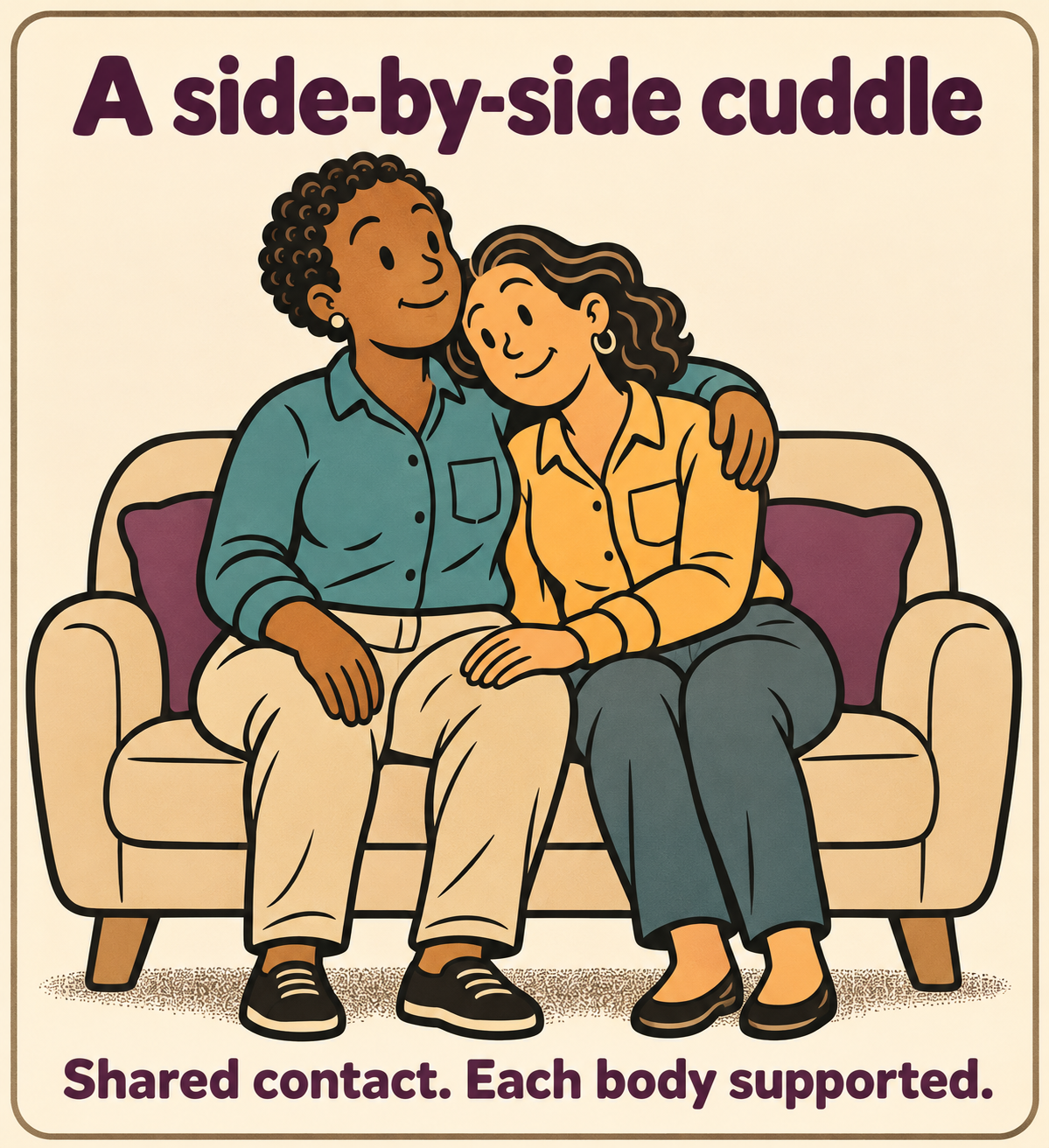
Make a side-by-side cuddle that works with an arm around someone or just two shoulders touching.
You both want to see the film. One of you would also quite like to spend it tucked against the other.
Start with two shoulders
Sit beside each other facing the screen, close enough that the outsides of your upper arms can meet. Each of you settles your own weight first. Then the person who wants to lean can bring one shoulder against the other and try a little of their weight there. It can be a very quiet sort of affection. You can feel the other person laugh before you hear it.
If you’d like to put your arm around them, offer it before they settle all the way in. They can tip forward just enough for your arm to come behind their upper back. Let your hand come to rest on their far upper arm if that’s what they like. If reaching that far makes your shoulder creep up, bring your arm back and let your near shoulders meet again.
Keep the bit you came for
“Can I put my head here?” If the shoulder is an easy height, let your head tip gently to it. If you’d have to fold your neck sideways to make it work, you can tuck your temple a little closer or keep your head up. The bit you might really want is their upper arm warm along yours. You can have the whole film’s worth of that.
If your companion straightens to take a drink, give them room. When they settle again, try offering your hand in the little gap between you. They might lace fingers, take the arm around them again, or sit close enough to trade remarks about the villain’s frankly excellent coat.
A QUICK NOTE TO YOURSELF
Keep one part of the sofa cuddle
Optional. Keep your notes private.
- Pick the part you’d want for a whole film. Would you ask for an arm around you, a shoulder to lean on or just a warm hand beside yours?
Try the two sides
Optional · At your own pace
- Sit the way you like to sit during a film. Let each arm hang comfortably, then curve one as if around someone beside you. Try the other side. Where can your shoulder stay low?
- Let the arm go. Shift enough to offer that same upper arm for a lean. Notice whether you’d rather give the wrap, take it or sit shoulder to shoulder.
Try this from your usual seat. A meeting of forearms or hands can bridge a gap between two seats.
With a partner
Settle side by side and try the shoulder contact first. Add an arm only if you both fancy it. Have the person leaning sit upright again so you can feel how easily the wrap opens.
Take with you: Two shoulders can make a perfectly good cuddle all by themselves.
Sources & further reading
03 · Spoon without sacrificing an arm
Lesson notes
Build a side-lying cuddle that leaves both people room to settle and move.
Someone has just offered to be the little spoon. Your top arm knows exactly what to do. Your bottom arm would like a word.
Give the bottom arm somewhere to live
Lie on your sides facing the same way. If you’re behind, leave a little space at first. Bring your lower arm forward on your own side of the bed, elbow comfortably bent, with the hand near your own face if that feels easy. If your partner’s head would land on your forearm, slide yourself a little lower or leave more room at the shoulders. Give that arm a place you could get it back from.
Now let the person in front come back toward you as far as they like. You might meet at the hips first and feel their back settle against your chest. “Can I put my arm around your waist?” If that’s where they want it, let your upper arm drape there. They can hold your hand, rest their own arm over yours, or go right on turning the pages of their book. A good spoon leaves a person free to finish the chapter.
Pick the bit worth keeping
You don’t need matching curves. If one pair of knees fits neatly behind the other, enjoy the extra warmth. If the knees bump, the person behind can draw theirs back. Keep the contact at the hip or back that felt good before the legs joined in. A long spoon with room between the feet can feel every bit as cosy.
If the lower arm gets pins and needles, say so and take the weight off it straight away. Open the upper arm and let the person in front move clear before you bring the lower arm out. Once you’re comfortable again you might prefer just a hand at the waist and a gap between your shoulders. If tingling persists or keeps coming back, get medical advice.
A QUICK NOTE TO YOURSELF
What makes it a spoon for you?
Optional. Keep your notes private.
- Would you miss the chest at your back, the warmth at your hips or the hand at your waist most? Put your favourite into an invitation.
Find a home for the spare arm
Optional · At your own pace
- Lie on a comfortable side if that suits you. Put your lower arm where you could rest it while reaching in front with the upper one. Lift or slide the lower hand away again. If that requires hauling your whole body over it, try another angle.
- Draw the knees up a little, then lengthen the top leg. Notice how much you can change at the knee without moving the arm you imagine resting around someone.
You can sit turned slightly sideways and rehearse just the loose top arm and the free lower elbow.
With a partner
Let the front person choose how far to come back. Try keeping their favourite point of contact while uncoupling your knees.
Take with you: Let the person in front choose the fit, and give both arms a way home.
Sources & further reading
04 · Face to face, with room for noses
Lesson notes
Settle facing each other at a distance that suits conversation, quiet or a little flirtation.
Eye to eye looks marvellous in the movies. At home you may discover a pair of glasses, two cold noses and somebody trying to finish a sentence.
Let the faces choose their distance
Lie on your sides facing each other. Get your own head and shoulder comfortable first. Leave enough space that you can focus on the other person’s face and speak easily. Reach across the small gap with your upper hand. You might like a palm resting on the outside of their upper arm, or to hold their hand between you. This can feel wonderfully private even with daylight between your chests.
For a closer cuddle, come nearer through the ribs or hips while leaving your heads a little apart. If your noses keep meeting, offset your heads slightly or turn one cheek outward. You can feel their breath and hear their voice without spending the evening staring at the bridge of their nose.
Where the knees go
Two people curling up toward each other can run out of room rather suddenly at the knees. Have one person lengthen their legs a little, or shift one pair of knees a little lower down the bed. If you both like a leg over a leg, ask and try it loosely. A shin pressed against a kneecap is a remarkably persuasive argument for uncrossing.
You might find yourselves talking, then closing your eyes and going quiet with one hand still held. Or one of you might want to turn away and keep just that hand. Facing someone is a lovely way to see their expression. It also works with your eyes shut and absolutely nothing clever to say.
A QUICK NOTE TO YOURSELF
How close is close enough?
Optional. Keep your notes private.
- You want to hear a whispered story but you’d like room around your face. How could you bring the rest of a cuddle nearer while leaving that space?
Make space in front
Optional · At your own pace
- Lie on a comfortable side, if you like, with the upper hand in front of you as if taking another hand. Curl both knees toward that hand. Then lengthen the upper leg a little and feel how much room opens up in front.
- Try facing straight ahead, then turn your cheek a little to the side. Find a head position you could comfortably talk from and one you’d choose for quiet.
Sit facing diagonally toward an imaginary partner and offer your hand across the gap. You can practise changing face angle and reach from there.
With a partner
Begin far enough apart to see each other clearly. Try bringing hands, hips or ribs closer one at a time. Let your faces stay at the distance each of you likes.
Take with you: Decide where you want contact. The faces can keep their own distance.
Sources & further reading
05 · Come rest your head here
Lesson notes
Cradle a head against a shoulder or upper chest while both people can settle easily.
Some nights the whole invitation fits into a pat on your shoulder and a quiet “Here?”
Find a landing place
Suppose you’re the person offering the shoulder. Settle into a comfortable recline with room beside you. Let your companion choose how to approach. If they want their ear against your upper chest, they can turn partly onto their side alongside you and come near until their head can rest there. If your chests are tender or you’d rather they stayed clear, offer the outside of your shoulder instead.
The one resting their head gets to find the angle. Move a little higher or lower along the other person until your cheek can lie comfortably, with your nose and mouth clear and your neck easy. An ear against soft clothing may pick up a low rumble when they speak. A zip against the very same ear is considerably less poetic. Move the fabric or choose another spot.
Give the head somewhere to leave from
Once they’re settled, ask whether they’d like your arm around their upper back. A palm on the far shoulder blade can make a light head rest feel like being gathered in. Keep the back of the head free. When somebody wants to look up at you, there’s no need for them to wrestle your forearm for the privilege.
If you’re holding and the head feels heavier than you expected, speak up early. “I love having you here. Can we move your cheek over to my shoulder?” Lift your arm to make room while they lift or move their own head in the way that works for them. If neither resting place feels easy, sit alongside each other again. You can keep listening to the story from there.
A QUICK NOTE TO YOURSELF
Offer a place you enjoy giving
Optional. Keep your notes private.
- Would you happily offer your chest, the outside of your shoulder or the hollow beside your upper arm? Give your guest a specific invitation.
Find the cheek angle
Optional · At your own pace
- Bring your flat hand lightly to your cheek, or lean it gently against a soft surface already beside you. Turn your face a little each way until your jaw is easy and your breathing is clear. Lift your own head away again.
- Now try the holder’s part. Recline or sit back and round one arm as if welcoming someone beside you. Open it far enough for them to look up. Which side would you offer first?
Use an upright shoulder lean, or touch your cheek to the back of your own hand without putting any weight through it.
With a partner
Let the person resting their head choose between two places the holder would enjoy. Try adding the arm once the cheek is comfortable.
Take with you: A person resting their head should be able to look up whenever they like.
Sources & further reading
06 · What does “hold me tighter” mean?
Lesson notes
Tell the difference between feeling surrounded and wanting more pressure.
“Can you hold me tighter?” Perhaps. Would they like a squeeze, or would they like more of you around them?
Make the hold fuller
Imagine you’re lying behind someone with a hand at their waist. They say they want to feel wrapped up. Try bringing your bodies comfortably closer and letting more of the inside of your upper arm rest along their side. Keep the elbow soft and your breathing easy. The change is how much of your arm they can feel. You may already have given them exactly the “tighter” they meant.
Someone else might want a brief squeeze around the upper back during a hug. “Like a little squeeze?” If yes, draw the arms in a small amount, then loosen them again. Ask whether that brief firmer moment was the good bit, or whether they’d rather have the gentle wrap back for longer.
Give the squeeze an off switch
Keep arms clear of the neck and leave breathing and movement easy. If either person feels restricted, release the hold. Leaning your body weight on someone’s chest makes it much harder for them to adjust how much pressure they feel. Keep your own weight supported and let your arms do the small job you agreed on.
It works the other way as well. “Could you loosen your arm but stay close?” Unbend the elbow a little and leave the palm resting where it was welcome. A hand can feel like company long after the squeeze is over.
A QUICK NOTE TO YOURSELF
Translate “a proper hug”
Optional. Keep your notes private.
- Think of what somebody would need to change to give you a lovely snug hold. Would their arms come farther around, would they briefly squeeze, or would they simply stay longer?
Compare coverage and squeeze
Optional · At your own pace
- Wrap your arms loosely around your own upper arms. Notice how much of each hand meets the fabric or skin. Rest more of the palm there without drawing your elbows in. Does the hold feel fuller?
- If comfortable, try a brief gentle squeeze on one upper arm with your opposite hand, then soften it. Compare that moment with the wider, still contact. Which would you call snug?
Rest one palm flat on the opposite forearm and compare more of the palm resting there with a small change of pressure.
With a partner
Ask for wider contact or a brief squeeze in a hold you already enjoy. Undo just that change and see which version you miss.
Take with you: When someone asks for tighter, give them a choice between more wrap and more squeeze.
Sources & further reading
07 · What should the hand do?
Lesson notes
Choose between a resting palm and a stroke someone will look forward to feeling again.
You’ve put an arm around someone. Now your hand is idling on their sleeve like an actor who’s forgotten the next line.
Let the hand rest first
A quiet hand can be the loveliest part of an embrace. Try letting a whole palm settle on a welcome spot such as an upper arm. Give the fingers somewhere soft to rest. If the other person’s shoulders settle, enjoy the stillness with them. If you’re wondering whether they’d like movement, ask. “Want me to stroke your arm or leave my hand here?”
For a stroke, begin in that same welcome place. Let the palm travel a short way down the upper arm and return at an easy pace. You can keep it in contact on the return or lift off and begin at the top again. Somebody who loves one-way strokes can really feel the difference. Ask which part they’d like another of.
Do the good bit again
If the first sweep tickles, stop the movement. They may like your palm resting there, a broader touch through a sleeve, or your hand elsewhere. Let them choose before trying a different stroke. You aren’t obliged to keep working at a ticklish patch until it develops better manners.
Perhaps they guide your hand to their upper back and say, “Right there. Slow.” Take a small route you can find again. Slow the return rather than wandering farther over their back. Once you have it, let a few strokes be alike. Knowing where your hand will come back can be the whole pleasure of it. If they fall quiet, you can let your palm come to rest in the hold they chose.
A QUICK NOTE TO YOURSELF
Name the part worth repeating
Optional. Keep your notes private.
- Imagine a hand goes down your arm and back. Which part would you ask for again, and how would you describe it in a few words?
Try two return trips
Optional · At your own pace
- Rest a hand on your other upper arm or thigh. Stroke a short way along it and slide back. Repeat the outward sweep, this time lifting the hand to return to the starting point.
- Try leaving the hand still after the next sweep. Which do you look forward to most, the stroke back, the next beginning, or the quiet weight at the end?
Use a short path on the back of the other hand or rest that hand against your forearm if repeated motion is tiring.
With a partner
Offer a still palm, then one wanted stroke. Let the person being touched choose how the hand returns.
Take with you: Once you’ve found a welcome stroke, you’re allowed to repeat yourself.
Sources & further reading
08 · When one of you is a furnace
Lesson notes
Trade a warm full-body cuddle for a smaller contact that suits you both.
Five minutes ago you wanted every inch of this person against you. Now you would quite like a breeze. You can be fond of someone in both temperatures.
Turn back to back
“I’m roasting. Backs together?” Open the front-facing hold and give each other room to turn independently. Once you’re each settled on a side facing away, move back a little until a small patch between your shoulder blades or along your backs meets. Try it lightly. It’s a companionable feeling, two people looking in opposite directions with one warm place in common.
Different heights might bring you together lower on the back or at the hips. Slide a little higher or lower if you’d both prefer a different meeting place. If one person needs space on a sensitive patch, leave it clear. There’s no need to reach an arm behind yourself to prove you’re still cuddling.
Keep just a little contact
If backs are still too warm, move apart enough that air can circulate. “Are your feet warm? I’d quite like one against mine.” Let the sides of your feet meet or lay the backs of your hands lightly together in the gap. Try it without winding legs or fingers together. You can both adjust while half listening to the rain.
For someone who runs chilly, an extra layer on their half of the bed can be more welcome than a hotter body on yours. At bedtime, ask whether either of you actually wants touch while falling asleep. “I love the cuddle. I sleep better with my own space” gives the evening two perfectly agreeable parts.
A QUICK NOTE TO YOURSELF
Choose a cooler second act
Optional. Keep your notes private.
- Which one point of contact would you miss if a big embrace got too hot? Decide what you’d like to keep and what you’d happily uncover.
Try a smaller meeting place
Optional · At your own pace
- Hold the insides of your forearms lightly together so there’s a broad area of contact. Then separate them except for a small patch. Feel where you still notice warmth and where moving air reaches your skin.
- Try touching just the sides of two fingers. Ease them apart and bring them together again. Find a small contact you can enjoy without having to hold yourself rigid.
Try the same comparison with your palms or feet, in the position where you already rest comfortably.
With a partner
Start in any cuddle you enjoy, then try back-to-back or one small shared point. Talk about how you’d change it if you were actually trying to sleep.
Take with you: Keep the piece of closeness you’d miss, and give the rest of you some air.
Sources & further reading
09 · Let the usual holder be held
Lesson notes
Choose who gives the feeling of being held, then fit the embrace to the arms you actually have.
The friend who always opens their arms has had a rotten week. Today they’d quite like to be the one who disappears into a hug.
Swap the job, then find the shape
“I want to hold you this time. Where would you like me?” The person receiving might want to settle with their side against yours and feel your arm around them. Try putting the reach in the easy direction. If you’re shorter, rest a hand across the near side of their back or wrap an arm around their waist if welcome. They can lower an arm or turn toward you to bring the place you both want within reach. Nobody needs to hang from anybody else’s neck.
Another way to hold someone taller is to be the little shape on the outside of a spoon. Lie behind them a little lower if that suits you. You can circle a top arm around a favourite part of their side while they hold your hand in front. Being the outside spoon describes a position. It has nothing to say about who is bigger or who usually looks after whom.
Let the person choose how you come near
If someone is already comfortable in their own seat or uses a wheelchair, ask where they’d like you. “On my left, please. I want to put my arm round you.” Bring yourself within reach on the side they chose. Let them direct any change to their own position or equipment. A hand, a forearm or one shoulder against yours may give them exactly the feeling of doing the holding.
Once the embrace settles, the person receiving can leave their arms at rest. A cuddle needn’t be paid for in equal quantities of stroking. If the familiar urge to look after the holder kicks in, ask what they’re enjoying. It’s rather nice to hear “Honestly? Getting to hold you for once.”
A QUICK NOTE TO YOURSELF
Ask for your less familiar part
Optional. Keep your notes private.
- Do you usually offer the arm or lean into it? Write the invitation that would get you the other turn in a position you enjoy.
Try giving with less reach
Optional · At your own pace
- From your usual seat, curve one arm as if holding someone at your side. Compare an imagined reach over a far shoulder with a hand resting on the nearer side of their back. Notice the part of your arm you could comfortably keep there.
- Now drop the arm and try the receiving role. Let your shoulder settle and imagine someone coming up to your preferred side. Is there a contact point you could offer without needing to hold them up?
Use a short reach, a hand to hand hold or an invitation spoken, typed or signed from where you already are.
With a partner
Have the usual holder name a place they’d like to be held. The other person chooses a comfortable reach, and both move only as they choose.
Take with you: Who gets gathered in today is yours to choose.
Sources & further reading
10 · A cuddle can stay a cuddle
Lesson notes
Practise saying what kind of closeness you want, hearing a counteroffer and changing your mind once you’ve settled in.
Two people can enjoy the very same embrace and have quite different hopes for the next five minutes.
Say what you came for
A friend crawls onto the other end of the sofa after a breakup. “Could you just hold me? I’ve had enough advice for one night.” A fine moment to retire your opinions. Ask where they’d like your arm, let them settle, and allow the quiet to last. They may want to talk once they’re there or they may want to fall apart a little in familiar company. The cuddle can do the job they came for either way.
With a lover, the same request can mean much the same thing. If you want affectionate touch without sex tonight, let them know while you’re finding the hold. “Come closer. I’d love to be wrapped up with you. I’m only up for cuddling.” They can decide whether they’d like that too.
Negotiate a cuddle before anybody scoots over
A cuddle can be a good place to practise consent because you can be wonderfully picky. You might want someone’s arm around you for a whole film and still want your hair left alone. When you say that out loud, the other person gets to find out something about you that an hour of polite guesswork wouldn’t tell them.
Say you’re on the sofa. “Can I pull you into my lap?” Your partner thinks for a moment. “I’d rather stay on my own cushion. Want to put your feet in my lap instead?” Now it’s your turn to consider their offer. If it sounds delicious, say so. If your feet are ticklish and you’d spend the film guarding all ten toes, “I think I’ll keep my feet down, but I’m glad you’re here” works too. Either of you can come up with an idea. Neither of you owes one.
A plain “No thanks” finishes the question. “Okay. Shall I start the film?” lets that answer be easy to give again. If you hear “I’m not sure,” leave the space between you as it is. And if somebody did want your feet in their lap until their leg started to ache, lift them off as soon as they ask. They get to change their mind even when nothing aches.
If you fancy a kiss
Suppose you’re face to face and you do feel a spark. “I’d really like to kiss you. Would you like that?” Stay where you are while they answer. A yes to the cuddle already told you something lovely. A yes to the kiss answers a new question. If it’s a no, there’s no need to make them defend it with your face still approaching theirs.
“No kiss, but stay here?” If that sounds good to you, settle back into the touch they were enjoying. If you’d prefer to sit up, you can say that kindly too. “I think I’ll sit up. Could we finish that story?” gives both of you somewhere to go from there.
A QUICK NOTE TO YOURSELF
Give yourself two honest answers
Optional. Keep your notes private.
- Pick a cuddle someone might offer you tonight. Write the answer you’d give if you wanted something slightly different, then the one you’d give if you wanted the whole sofa cushion to yourself. Which sounds most like you? You can cross out any apology you put in out of habit.
Take turns asking
Optional · At your own pace
- On your own, pick one invitation you’d actually enjoy making. Say it aloud, type it or sign it. Now take the other part. Try “yes,” a plain “no,” and a different offer you might genuinely like. After each, switch back to the asker. What would you say or do next? For the last turn, imagine their counteroffer doesn’t appeal to you either. How would you turn it down and let them know you’re glad they told you what they like?
- Imagine you both said yes and settled in, then one of you wants out. Say the words you’d use. Open your hand or move your arm away as you rehearse hearing them. If you tend to add “Why?”, try that ending once more with just “Of course.”
Use speech, a message, a gesture you both understand or your usual communication device. You can do the whole exchange from where you already sit.
With a partner
Together, start a cushion apart. Take turns making one real invitation each. Give each other time to choose. If you both want the same hold, try it, then practise asking for a change or an end. You can also play both rounds with words alone. Afterwards, ask each other, “Was there anything I did that made it easier to tell me what you wanted?”
Take with you: Ask for the next thing while the other person can still choose this one.
11 · Find your place in a cuddle puddle
Lesson notes
Join or leave a three-person cuddle while each person chooses their own points of contact.
You can see a warm little gap beside two people who are curled up together. An empty patch of floor is available. The people are another matter.
Three people, three different cuddles
At a private gathering, Billie and Ash are sitting on a broad rug, shoulder to shoulder. Ren would like to join on Billie’s free side. “Billie, would you like my shoulder against yours? Ash, are you happy staying like that if I sit here?” Wait for each answer. A person who’d rather stay out can have a perfectly good evening within chatting distance.
Suppose everyone likes the idea. Ren settles on the outside, carrying their own weight. Billie gets a warm shoulder on either side and wants to hold Ash’s hand. Ren likes just the shoulder. Ash and Ren never need to touch each other. A three-person cuddle can be as simple as that, and the middle person can face forward with their arms free. Give each other enough room that nobody has to lean on someone else to stay upright.
Leave a door in the middle
“Tea. Both of you are lovely, but tea.” When Billie wants to leave, Ash opens their hand and both outside people sit up and move clear. Billie can sit forward or get up in their own way. Ren and Ash now have a new choice. They might want to sit together and take hands. They might prefer to chat across the space Billie left. Ask before closing that gap.
At a facilitated Cuddle Party event the organizers describe their format as clothed and nonsexual. They ask participants to get a verbal yes before touch, allow changes of mind, and welcome people who choose to watch or take a break. Ask the facilitator about access or a particular situation. Once you know what’s welcome there, you can spend your attention on the real invitation, like “Would you like my shoulder beside yours?”
A QUICK NOTE TO YOURSELF
Invite one person at a time
Optional. Keep your notes private.
- Imagine sitting at the edge of a cuddle you’d like to join. What would you ask the person beside you? Whose existing contact or space could change, and what would you ask them?
Try the middle seat
Optional · At your own pace
- Sit or stand comfortably and imagine one person beside each shoulder. Find an upright position you could keep if one of them moved away. Offer one hand to one side while leaving the other arm relaxed.
- Open the hand and make your own movement out of the middle. Try again with the two people in your imagination making a little room first. What would you ask them to release or move?
Use the position you already rest in. You can rehearse indicating which side someone may approach and asking them to leave that route clear.
With a partner
With three willing adults, build a loose row with two separate agreed contacts. Let the middle person choose their own way out. If two remain, make a fresh choice about any new contact.
Take with you: A cuddle puddle is made of individual invitations. Each person keeps their own way out.
Sources & further reading
12 · Stay, shift, or let go
Lesson notes
Change or end a cuddle in a way that makes your intention easy to feel and hear.
Your foot wants to leave, your hand would happily stay, and the person tucked into your side has no idea which one is about to win.
Keep one thread if you want it
You’re on the sofa with an arm around your partner. Your free hands are loosely joined in their lap. “I’m going to sit up,” they say. “Can we keep holding hands?” Open the arm around them first. If your joined hands can travel with them easily, let them. If either wrist twists, let go and offer your hand again once they’re sitting up.
A bigger turn works better in two parts. If you’re spooning and want to face each other, loosen the wrap, move far enough apart to turn, then come back toward the new hold. A little warm contact between turns is welcome only if it makes moving easy. Getting your own elbow back is an excellent reason to let every last finger go.
Give the ending its due
Sometimes there’s no next hold. “I’m ready to get up. That was lovely.” Start opening your arms as you say it. If someone asks to be let go, release them right away. Save the last affectionate squeeze for a time when somebody has actually asked for it.
If one of you enjoyed the cuddle long after the other was done, you can still name what was good without bargaining for another minute. “I loved having your cheek there.” That little detail can come home with them. The next time you meet, you can ask if they fancy it again.
A QUICK NOTE TO YOURSELF
Pick the ending you’d like to hear
Optional. Keep your notes private.
- Choose an ending for a particular cuddle. Do you want to keep a hand, offer a different hold, or step away entirely? Put that choice into one line.
Unwind a hold in two moves
Optional · At your own pace
- Settle into the shape of a hold you enjoyed rehearsing. Notice which arm or leg would have to be free for you to change position. Open the hold first, then make the change at your own pace.
- Try two endings. In one, finish with a hand resting against your other hand as a stand-in for shared contact. In the other, let both hands come away. Which feels more like a shift, and which feels finished?
While sitting, bring one arm across yourself or rest your hands together. Practise opening the contact before making the movement that comes next.
With a partner
Try a cuddle you both want. Have one person ask to change it, then, at another moment, ask to end it. On the ending let go fully and let them choose what comes next.
Take with you: There’s warmth in being held and warmth in being let go as soon as you ask.